The fastest machine isn’t automatically the right choice for commercial floor polishing. Low-speed buffers generally run at around 150-175 RPM, whilst high-speed burnishers operate at 1,000-1,500 RPM or more; buffers suit slower floor-care tasks, while burnishers are used for a high-gloss finish. The right machine and method depend on the flooring and its condition.
It’s easy to assume that a more powerful machine will deliver a better result, but speed, pad choice and polish all need to suit the floor. A delicate surface such as marble needs a different approach from flooring that can withstand more intensive treatment.
This guide explains the differences between polishers, buffers and burnishers, and how to match machine speed and polish products to the floor. It also covers essential preparation and how a commercial floor’s material and condition shape the work.
Key Takeaways
- Match the cleaning method to the floor material and its condition, particularly on delicate surfaces such as marble.
- Choose machine speed for the task: slower, even passes can address heavy scuffs, while faster polishing supports a gloss finish.
- Select polish and cleaning chemicals for the specific floor, since some products can be too abrasive for certain materials.
- Prepare the area by clearing dust and debris, and keep the machine moving to help avoid an uneven finish.
- Understand which commercial and industrial machines are suited to preparation work and which are designed for polishing.
What Are Floor Polishers / Buffers / Burnishers?
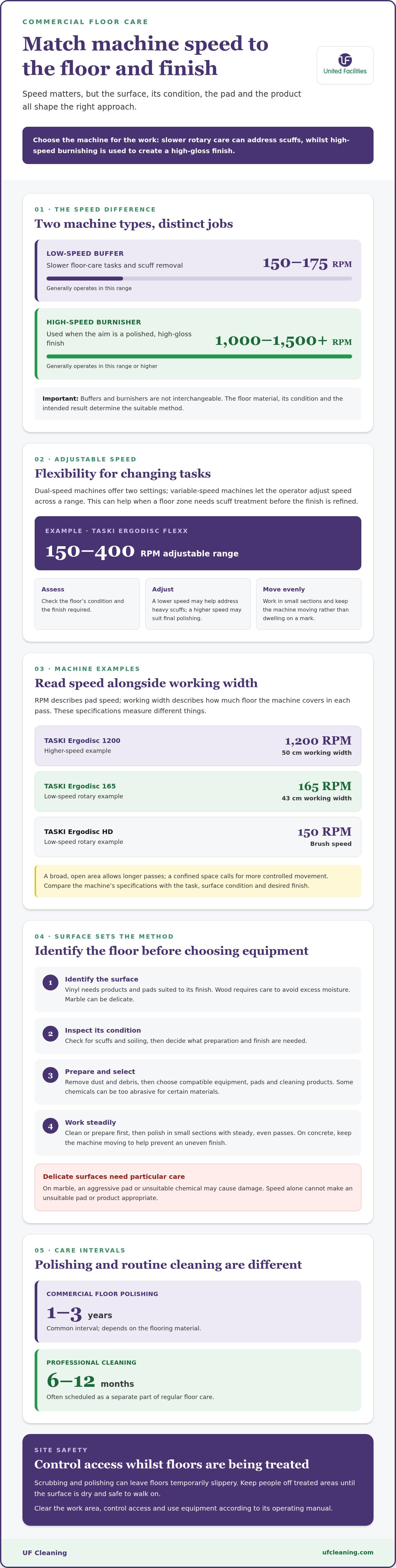
A floor polisher is a broad term for equipment that cleans, prepares or finishes hard flooring. A low-speed buffer generally runs at 150-175 RPM, supporting slower floor-care tasks and scuff removal. A high-speed burnisher runs at 1,000-1,500 RPM or more, and is used when the aim is a polished, high-gloss finish. These machines aren’t interchangeable: the floor material, its condition and the intended result determine the suitable method.
Cleaning methods vary by surface. Vinyl needs products and pads suited to its finish, while wood requires care to avoid excess moisture. Natural stone, including marble, can be delicate, so an aggressive pad or unsuitable chemical may damage it. Carpet cleaning uses a different process from hard-floor polishing and isn’t a job for a rotary floor buffer. Identify the material first, then choose compatible equipment and cleaning products.
Commercial floor cleaning in workplaces can involve offices, schools, retail premises and industrial sites, each with distinct flooring and operating needs. A practical sequence is to identify the surface, inspect scuffs and soiling, remove dust and debris, then select the machine and product. Scheduling work around site activity can help minimise disruption. Specialist equipment and skills are especially important in buildings with vinyl corridors, carpeted rooms and stone entrances.
When choosing a commercial floor polishing contractor, prioritise a clear assessment of the floor material, condition, preparation and desired finish. The proposed equipment and method should suit each surface, rather than applying one process throughout a building with mixed flooring.
Commercial floor cleaning requires workplace procedures suited to the task and site. Scrubbing and polishing can leave floors temporarily slippery, so manage access and follow site safety procedures while surfaces are being treated.
First remove debris, dirt and dust, then identify the floor and select suitable equipment and products. Clean or prepare the surface before polishing in small sections with steady, even passes. On concrete, keep the machine moving to help prevent an uneven finish.
Commercial floors are commonly polished every 1 to 3 years, depending on flooring material. Regular cleaning is a separate part of care, with professional cleaning often scheduled every 6 to 12 months.
There is no single duration or re-entry time for every site. Floor area, condition, preparation and product drying requirements all affect how long the work takes and when the floor can be used. Keep people off treated areas until the surface is dry and safe to walk on.
The price depends on the floor area, material, condition, preparation and desired finish. It is based on a free, no-obligation quote.
Key risks include slipping on temporarily wet or polished flooring and coming into contact with operating machinery. Clear the work area, control access and use equipment according to its operating manual.
Adjusting speed to the task and floor condition
Choose machine speed according to the work and surface, not simply the desired pace. Low-speed buffers generally operate at 150-175 RPM, while high-speed burnishers run at 1,000-1,500 RPM or more.
Dual-speed and variable-speed machines
A dual-speed machine offers two operating settings, while a variable-speed model lets the operator adjust speed across a range. This flexibility can help match the machine to changing tasks, such as addressing scuffs before refining the finish. The TASKI Ergodisc Flexx, for example, has an adjustable speed range of 150-400 rpm.
Consider the machine’s available settings and the work planned for each floor zone. A single-speed machine offers less flexibility if one area needs preparation and another a finer finish. Speed adjustment is only one consideration: the pad, product and floor material must also suit the surface, particularly if marble is present.
Choosing speed settings for floor condition
Start by assessing the floor’s condition and the result required. A lower speed may be needed to remove heavy scuffs, while a higher speed may be appropriate for final polishing. This helps prevent the mistake of treating every mark as a reason to increase speed.
With a variable-speed machine, work in small sections and move slowly and evenly across each one. Adjust the setting to the task, and keep the machine moving rather than dwelling on a mark. For a delicate surface such as marble, the material must guide the approach: speed alone cannot make an unsuitable pad or product appropriate.
Working width and machine speed
Working width affects how much floor a machine covers in each pass, while RPM describes pad speed. The TASKI Ergodisc 1200 runs at 1200 rpm with a 50cm working width. By comparison, the TASKI Ergodisc 165 runs at 165 RPM with a 43 cm working width.
These specifications describe different machine characteristics, not a universal measure of cleaning performance. Consider the floor layout as well as speed: a broad, open area allows longer passes, while a confined space calls for more controlled movement. Compare both figures with the task, surface condition and desired finish before choosing equipment.
Low-speed rotary machines
Low-speed rotary machines generally operate at around 150-175 RPM and suit slower floor-care tasks. The TASKI Ergodisc 165 operates at 165 RPM, while the TASKI Ergodisc HD has a brush speed of 150 rpm. These examples show why the model’s stated operating speed matters when matching equipment to the job.
Use the floor condition to guide the sequence: a lower speed may help address heavy scuffs, while final polishing may call for higher speed. Keep passes even and the machine moving to support a consistent finish. For workplaces requiring a considered hard-floor maintenance approach, Office Hard Floor Cleaning is a relevant service.
Proper speed selection remains essential for every stage of the task. A commercial floor polisher should have variable speed settings to help achieve the desired finish. The TASKI Ergodisc 200 operates at 200 RPM and has a 43 cm working width.
Chemical suitability for floor types
A cleaning chemical that suits one surface may be too abrasive for another. Before choosing a product, identify the floor material and existing finish. Vinyl, sealed wood, concrete and natural stone each respond differently to cleaning agents. For example, a solution suitable for resilient vinyl may be inappropriate for marble. Matching the product to the floor helps protect its appearance and support effective cleaning.
Distinguish the product’s purpose from its name. A cleaner removes soil, while a polish is intended to change or maintain the floor’s finish. Detergent residue can affect the appearance of a polished surface, and an unsuitable polish can create a finish that doesn’t suit the material. Read the label and follow the stated dilution and application method, rather than assuming one product will suit every floor type.
For sites with mixed surfaces, create a simple floor-and-product schedule. Record the material, finish, approved product and cleaning method for each area. A vinyl corridor, timber meeting room and stone reception may need separate entries, even if they share a cleaning routine. This helps staff identify the equipment and products for each zone, reducing the risk of using a chemical intended for a different surface.
- Vinyl: Choose a product intended for the floor’s material and finish. Avoid substituting a stronger cleaner simply because traffic has left visible marks.
- Wood: Follow product directions for the floor’s finish, and avoid a wet application unless its instructions permit it.
- Natural stone: Use a method designed for that stone. Marble is a useful example of a delicate surface that needs careful product selection.
- Concrete: Match the cleaner to the surface and the soil being removed, then clear residue as directed.
Before work begins, check each product’s label for the intended surface, dilution, application and removal instructions. Keep containers clearly identified and products separate by area, so a stone-floor solution isn’t mistaken for one intended for vinyl. If the floor material or finish is uncertain, identify it before choosing a chemical. This is particularly important when old coatings or repairs may make the surface behave differently from adjacent flooring.
In workplaces such as kitchens, reception areas and shared corridors, hygiene matters as much as appearance. Select a product suited to both the floor and the cleaning task: a stronger chemical isn’t automatically more appropriate. A careful method protects the finish, limits unwanted residue and helps keep routine floor cleaning consistent. On sites with several floor types, documenting product choices makes the process easier to repeat.
No single polish or finish is best for every surface. Choose a product intended for the specific floor material and existing finish, and follow the label instructions.
Floor polish product and application
The right finish depends on the floor material, existing surface and desired result. Apply it in a controlled sequence, since preparation and even coverage affect the final appearance.
Choosing polish for different floor types
No single polish or finish suits concrete, terrazzo, vinyl and stone equally. Identify the material and existing coating first, then choose a product intended for that surface. Concrete needs a method suited to its condition; keeping the machine moving helps prevent an uneven finish. Terrazzo and stone also require compatible products, while vinyl needs a finish designed for resilient flooring.
For marble and other natural stone, prioritise material suitability over gloss alone. Some chemicals may be too abrasive for certain floor types. Read the product directions and match the polish to the surface and intended appearance. If the site includes carpets, keep carpet cleaning separate from hard-floor polish application: the processes and equipment differ.
Applying floor polish
Prepare the area before opening the polish: remove dirt, dust and loose debris, then clean the floor using a compatible method. Check the equipment manual and product label for application instructions. Work in small sections, applying the product evenly and keeping the machine moving across concrete to reduce the risk of an irregular finish.
Follow the stated application and drying instructions rather than adding coats by guesswork. Keep people away while the surface is being treated, as commercial scrubbing and polishing can leave flooring temporarily slippery. When the finish is ready for use, inspect the surface under normal lighting. Check edges and traffic lanes for missed patches or visible variation.
Maintaining polished floors
Regular cleaning suited to the material helps remove grit before it spreads across a commercial floor. Use a compatible cleaner and avoid abrasive products that may affect the finish. Entrances and busy walkways may need closer attention, as tracked-in dirt and repeated foot traffic can dull their appearance sooner than quieter areas.
Plan maintenance around the floor’s material and condition. Professional floor cleaning is recommended every 6 to 12 months, while professional polishing is recommended every 1 to 3 years, depending on flooring material. Between treatments, follow a consistent cleaning routine and address visible scuffs with a suitable method. This helps preserve the finish and can reduce the need for premature intensive restoration.
Commercial and industrial floor polishers
Commercial and industrial machines must suit the floor, the preparation required and the desired finish. Speed alone doesn’t determine whether a machine is appropriate. A high-speed burnisher can refine gloss, while a grinder prepares a surface. Match the machine to the task before work begins.
Consider the Nilfisk BU500 Burnisher/Polisher Machine, specified as a 1500 RPM model. That speed makes it an example of equipment intended for high-speed burnishing, rather than a universal solution for every industrial floor. By contrast, the TASKI Ergodisc HD has a brush speed of 150 rpm. These specifications describe different operating speeds and should be considered alongside the floor material and condition.
Preparation also affects machine choice. A machine intended for preparation grinding may not be suitable for polishing. If a floor needs a polished finish, choose equipment designed for that stage instead of expecting a preparation grinder to do both jobs. In industrial areas, inspect the surface and clear debris first. Bolts can damage grinder heads and puncture dust-extractor hoses or filters, so remove them before operating equipment.
- For preparation grinding: Choose a machine suited to the surface and the required preparation, then clear dust and debris from its path.
- For a gloss finish: Use a high-RPM burnisher, such as a 1500 RPM model, where the floor and task are suitable.
- For controlled floor care: A lower-speed machine, such as the TASKI Ergodisc HD at 150 rpm, serves a different role from a high-speed burnisher.
Where dry grinding is appropriate, it avoids creating slurry, making dust extraction an essential part of the setup. Clear the work zone, inspect hoses and filters, then follow the operating manual before starting. Keep the machine moving in steady passes and work methodically across the floor, rather than repeatedly concentrating on one spot.
Industrial sites also need a safe working sequence. Commercial floor scrubbing and polishing can leave a surface temporarily slippery, so follow site health and safety procedures and control access during treatment. Choose the machine based on floor type, visible damage, debris, preparation needs and desired finish. A specialist assessment can distinguish grinding requirements from polishing work.
For workplaces with demanding hard-floor requirements, arrange industrial and manufacturing cleaning to support a suitable approach to floor care. Equipment selection should remain specific to the surface and task, with preparation, dust control and finishing treated as separate steps where needed.
UF Cleaning: Office Cleaning London
UF Cleaning provides comprehensive workplace cleaning and office hard-floor care for organisations that need coordinated maintenance. Regular floor care can form part of a broader cleaning plan, with the method selected to suit the floor material and condition.
For commercial floor polishing, identifying whether a surface needs routine cleaning, polishing or more intensive preparation helps define the work. Sharing the floor type, visible wear and operational requirements is a useful starting point for discussing the right approach. UF Cleaning also delivers integrated workplace cleaning solutions for organisations seeking specialist hard-floor care.
Contact UF Cleaning to discuss your office cleaning requirements.
Plan the next stage of floor care
Make the next step a clear maintenance plan, not simply a decision to restore shine. Record the floor materials, areas with visible wear and the finish your workplace needs. This gives your facilities team a practical basis for planning commercial floor polishing alongside routine cleaning, and focuses attention on the surfaces that need it most.
UF Cleaning provides Office Cleaning London, Housekeeping and Hotel Management. For workplaces where floor care is part of office cleaning, these services provide a practical starting point for discussing the cleaning requirements and the needs of the environment. Share the areas you want addressed and the outcome you’re aiming for to focus the discussion on a suitable next step.
Contact UF Cleaning about floor polishing and take the next step towards a considered floor-care plan.
Frequently Asked Questions
What types of commercial floors can be polished?
Many commercial hard floors can be polished when the treatment suits their material and existing finish. Examples include sealed concrete, terrazzo, vinyl and some natural stone surfaces. Wood may need a finish-specific treatment rather than a standard polishing method. Carpets aren’t polished; they need carpet cleaning. In buildings with mixed flooring, identify each surface separately before choosing products or planning work, especially if repairs or coatings have changed its finish.
What is the difference between floor polishing, buffing and burnishing?
Polishing is a broad term for treating a floor to improve or maintain its finish. Buffing usually describes machine work that cleans or refines the surface, while burnishing refers to high-speed machine work aimed at a glossier appearance. These terms can overlap in everyday use, so a clear work plan should specify the intended result, process and area, rather than relying on the equipment name alone.
Can commercial floor polishing be done outside business hours?
Work can be scheduled outside a premises’ normal opening hours to limit disruption to staff, visitors or customers. The area must still remain clear during treatment and until the floor is dry and safe to use. For example, a reception floor could be isolated while other parts of the building remain accessible, provided routes and access arrangements are planned around the work.
How long does commercial floor polishing take, and how soon can the floor be used?
The time required depends on the floor area, condition, preparation and product drying requirements. Keep people off treated areas until the floor is dry and safe to walk on.