What if your cleaning schedule could adapt to occupancy, opening hours and seasonal demand without standards slipping? A rigid plan can quickly become a poor fit, while unclear task ownership may leave essential areas overlooked or work unnecessarily repeated. The answer is not simply to change cleaning frequencies, but to set clear priorities and responsibilities from the outset. This guide to flexible cleaning contracts that businesses can use starts with a schedule that makes those details explicit, backed by the expert commercial services of UF Cleaning.
It’s understandable to want a service that can adapt as your operations change while keeping quality and costs manageable. A useful agreement defines what must be cleaned, how often each task is completed, who is responsible and how adjustments are agreed.
Use the schedule template below to record site-specific priorities, distinguish core tasks from variable ones and establish a straightforward review process. You’ll also find ways to maintain oversight between reviews, so changes in occupancy or demand can be reflected without losing sight of consistent service standards.
Key Takeaways
- Record site details, cleaning priorities and task ownership in a reusable schedule template.
- Compare fixed, variable and hybrid arrangements to find a schedule that fits how your business operates.
- Use clear change controls to document adjustments and keep responsibilities easy to follow.
- Build quality checks and review points into a flexible cleaning contract, so changing requirements don’t obscure service standards.
- A tailored recurring plan can bring together cleaning schedules, labour, eco-friendly supplies and quality monitoring.
What makes a flexible cleaning contract reliable rather than unpredictable?
A flexible cleaning contract is an agreed service framework that allows schedules to adapt while keeping the scope, responsibilities and expected standards clear. It gives a business room to respond when site use changes without relying on informal requests or leaving cleaning staff to decide which tasks matter most. Flexibility should make service delivery more responsive, not less defined.
Occupancy, opening hours and footfall can all affect where and when cleaning is most useful. A busy reception may need more frequent attention during a period of high visitor traffic, while quieter office areas may need less frequent routine cleaning. Seasonal demand can also shift priorities, such as increased attention to entrances during wet weather. The agreement should specify what can change, who approves an adjustment and when its effect on quality will be reviewed.
This structure shares principles with a Service-Level Agreement (SLA), which documents service expectations and responsibilities. A clear record gives everyone a shared reference point as operational needs evolve.
Which parts of a cleaning agreement can be adapted?
Adjustable details may include task frequency, preferred cleaning times, priority areas and the balance between routine and periodic work. For example, a business might increase attention to shared kitchens during a busier period while retaining the same agreed approach to washroom hygiene. A change in occupancy does not automatically mean every requirement needs to change. Base the schedule on actual site use rather than applying a blanket increase or reduction.
Separate variable details from core hygiene and quality expectations. The schedule can state that a task’s frequency or timing may be reviewed while its description and expected outcome remain consistent. This prevents vague instructions such as “clean the kitchen” from leaving room for different interpretations. Specify the relevant surfaces and the result expected.
How can flexibility protect consistent standards?
For each priority area, record a written task description, the person or team responsible and the expected result. Include a preferred time window if it affects access or daily operations. These details make ownership visible and help prevent missed or duplicated work when the schedule changes.
Set review points so temporary changes don’t become permanent by default. At each review, consider operational changes, service feedback and quality records. Then document whether the adjustment should continue, change again or end. This gives updates a clear route from request to approval and review.
Flexible cleaning means adapting schedules within documented responsibilities and standards, not leaving service expectations open to interpretation.
Build your flexible cleaning contract with this reusable schedule template
A practical schedule turns site requirements into clear instructions that can be reviewed and adapted. Use the template below as a starting point for flexible cleaning contracts London businesses need, then tailor the fields to your facility and operating pattern.
What information should the site profile capture?
Start with the context cleaning staff need to understand the site. Record the facility type, areas included, operating hours, access arrangements and usual occupancy or footfall patterns. Note where use varies, such as meeting rooms that fill on office days or a retail entrance that becomes busier during seasonal trading. Identify sensitive or high-priority areas and briefly explain why they matter to your operations.
How should the schedule template define cleaning tasks?
Group work by location and describe specific actions and observable outcomes, rather than relying on broad labels such as “general cleaning”. For example, state which kitchen surfaces are to be wiped and what the finished area should look like. Separate routine tasks from periodic work, and mark seasonal or occupancy-led requirements as adjustable. As Service Level Agreements guidance illustrates, clear expectations and review arrangements help make an agreement workable.
A schedule becomes actionable when each task is linked to a location, frequency and responsible person.
Copyable cleaning schedule template
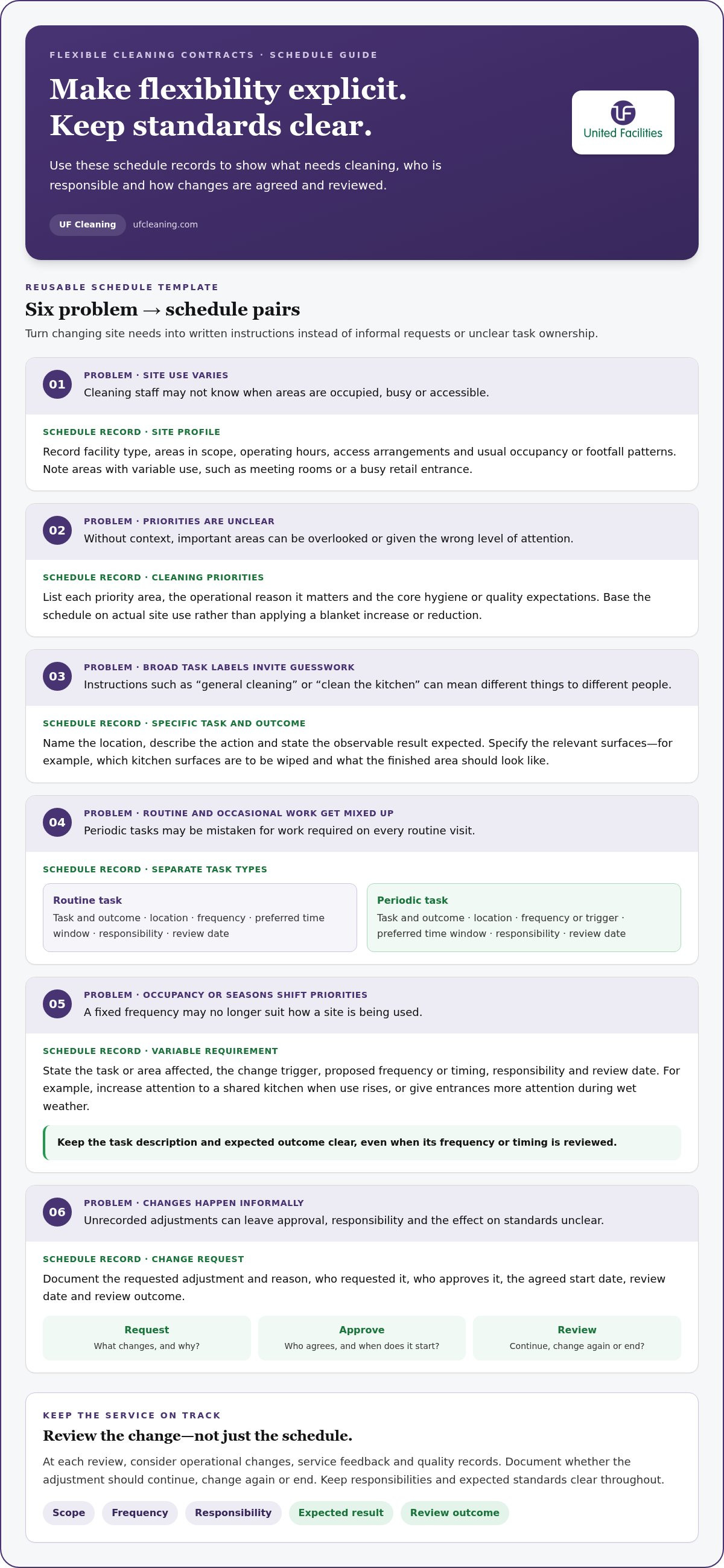
- Site profile: Facility type; areas in scope; operating hours; access arrangements; usual occupancy or footfall patterns.
- Cleaning priorities: Priority areas; operational reason; core hygiene or quality expectations.
- Routine task: Task and observable outcome; location; frequency; preferred time window; responsibility; review date.
- Periodic task: Task and outcome; location; frequency or trigger; preferred time window; responsibility; review date.
- Seasonal or occupancy-led requirement: Task or area affected; change trigger; proposed frequency or timing; responsibility; review date.
- Change request: Requested adjustment; reason; person requesting; approver; agreed start date; review date; review outcome.
For example, a shared kitchen could have a routine surface-cleaning task, with an increase in frequency when use rises. A separate periodic task can be listed without making it part of every routine visit. This distinction shows what is essential, what is scheduled at intervals and what may change as site conditions shift.
Use the change-request fields for every agreed adjustment, even if it seems minor. Recording the reason, approval and start date creates a clear reference for the next review. The review outcome can confirm whether the change should continue, be revised or end.
When your template is ready, it can form the brief for a site-specific service plan, such as a tailored cleaning proposal.
Compare fixed, variable and hybrid cleaning schedules before choosing
The right schedule depends on how consistently your site is used and how often its cleaning priorities shift. A fixed routine offers a predictable pattern; a variable schedule responds more directly to activity; and a hybrid combines reliable core tasks with agreed adjustments. Compare the practical trade-offs to choose a model that fits your operations, rather than adding flexibility where it isn’t needed.
| Schedule type | Predictability | Adaptability | Administration | Suitable operating conditions |
|---|---|---|---|---|
| Fixed | High: tasks and frequencies follow a set routine. | Lower: changes require a review of the agreed schedule. | Simple to communicate and monitor once responsibilities are established. | Stable occupancy and well-understood cleaning needs. |
| Variable | Less consistent: service levels can respond to changing activity. | High: tasks or frequencies can be adjusted as site use changes. | Needs clear change requests, approvals and review records. | Sites with fluctuating occupancy, events or seasonal activity. |
| Hybrid | Core tasks remain regular and defined. | Targeted adjustments can be made for agreed operational changes. | Requires clear rules for which tasks are fixed and which can vary. | Sites with stable essential needs and some changing demands. |
When does a fixed cleaning schedule make sense?
A fixed schedule suits sites where occupancy, opening patterns and cleaning priorities remain relatively consistent. Regular frequencies make it easier to explain who is responsible for each task and to monitor whether the agreed routine is being delivered. It also provides a straightforward basis for recurring cleaning. Include a review process so the arrangement can be reconsidered if site use changes.
When are variable or hybrid cleaning schedules more suitable?
A variable schedule may suit a facility where footfall changes substantially, or where events and seasonal patterns affect which areas need attention. To keep it manageable, define what activity can trigger an adjustment, who can approve it and how the change will be recorded. Without those controls, frequent amendments can be difficult to track.
For many sites, a hybrid approach offers a considered balance. Keep essential routine tasks on a dependable schedule, then agree how selected tasks can shift when occupancy, events or other operating conditions change. For example, core washroom cleaning might remain scheduled while attention to a high-traffic entrance is adjusted during a busier period. This preserves a clear service foundation while letting the schedule respond to actual use.
When comparing flexible cleaning contracts London businesses may consider, match the model to the pattern of demand. Choose fixed where needs are stable, variable where activity frequently changes, or hybrid where essential routines need to sit alongside controlled adjustments.
Set change controls and quality checks that keep a flexible contract on track
A cleaning schedule can adapt reliably only when each change has an agreed route. Define who may request an adjustment, who reviews and approves it, and where the decision is recorded. This keeps site teams and cleaning staff working to the same current expectations instead of relying on verbal updates or outdated instructions.
What should a schedule-change process include?
For each request, record the reason, affected areas, proposed adjustment and intended duration. Note who raised it, who approved it, when it should begin and when its suitability will be reviewed. At that review, document the outcome: continue the change, revise it or return to the previous arrangement. Recording even a temporary adjustment helps prevent it becoming permanent by default.
Keep one clear record of agreed updates and make it available to the people responsible for managing and delivering the service. For example, if a change in occupancy leads to more frequent attention in a shared area, record the revised task, its start date and when the need will be reassessed.
How can quality checks support an adaptable service?
Connect each agreed task with a visible check and a follow-up responsibility. If a task is missed or an area falls short of the agreed outcome, record what happened, who will address it and how completion will be reviewed. When priorities change, update the check against the revised schedule so quality oversight reflects the current agreement.
Review the schedule at agreed intervals, and bring reviews forward when operational patterns change or feedback and monitoring indicate a recurring issue. Look for patterns across records rather than relying on a single impression. This helps distinguish an isolated missed task from a repeated gap that may call for clearer instructions, a change in frequency or another corrective action.
UF Cleaning uses the Taskbe platform for real-time quality monitoring, providing visibility between formal reviews. Monitoring records can make service discussions more specific, while agreed standards and the review process remain the basis for decisions. Operational support can help maintain a considered service relationship, but it does not replace clear responsibilities or recorded changes.
Documented standards, regular reviews and recorded adjustments let a cleaning schedule respond to changing needs without losing consistency.
To discuss flexible cleaning contracts London shaped around your site and operating requirements, request a tailored cleaning proposal.
Turn your cleaning schedule template into a tailored service plan
A completed template gives UF Cleaning a practical brief for shaping recurring commercial cleaning around your site requirements and preferred schedule. The handover should turn that brief into a clear operating plan, so agreed priorities are understood by the people managing and delivering the service.
What should happen before a tailored cleaning plan begins?
Gather the details that influence delivery: facility type, areas in scope, access arrangements, operating patterns and priority areas. Note where occupancy or activity varies, and identify operational changes that could affect cleaning needs. This context helps distinguish essential routine work from tasks that may need adjustment.
Next, translate the agreed brief into specific tasks, frequencies, responsibilities and quality-review arrangements. Recurring agreements can include labour and eco-friendly cleaning products, with the schedule setting out how the service is organised at the site. Before delivery begins, clarify how relevant teams will receive schedule updates and report changes in site use or priorities. A consistent handover reduces the risk of outdated instructions or unclear ownership.
For organisations considering flexible cleaning contracts London, this preparation makes the service adaptable without leaving expectations open to interpretation. The plan should show both the agreed routine and the process for reviewing it.
How should the service plan evolve over time?
Revisit the service plan when occupancy, operating hours or facility priorities change, and when feedback or quality records point to a recurring issue. Use reviews to make focused adjustments. For example, change the frequency of a task in one area rather than altering the whole schedule. Record the decision, who is responsible for communicating it and when its suitability will be reviewed again.
UF Cleaning provides real-time quality monitoring through the Taskbe platform, giving teams visibility between formal reviews. Combined with service feedback and clear responsibilities, monitoring records provide a practical basis for discussing delivery and deciding whether an adjustment is needed. UF Cleaning’s operational support also forms part of the service relationship, alongside documented standards and agreed review arrangements.
With a considered handover and regular oversight, a cleaning schedule can stay aligned with your organisation as its needs change. A cleaning plan tailored to your organisation can set out those priorities and review arrangements.
Make your cleaning schedule work as your business evolves
A reliable flexible cleaning contract combines clear task ownership and quality expectations with a defined process for adapting frequencies and priorities as site needs change. Choosing a fixed, variable or hybrid schedule gives you a practical starting point, while documented reviews help keep adjustments manageable and standards consistent.
UF Cleaning has served organisations since 2010, tailoring recurring agreements around site requirements and preferred schedules. Agreements can include labour and eco-friendly cleaning supplies, with real-time quality monitoring through the Taskbe platform and 24/7 operational support. These elements can help keep a service plan visible and responsive as operations evolve.
Take the next step with a cleaning plan shaped around your priorities and schedule. Request a free quote for a tailored cleaning plan.
Frequently Asked Questions
What is a flexible cleaning contract?
A flexible cleaning contract is an agreed service plan with clear tasks and standards that allows schedules to be adjusted as a site’s needs change. It can set out routine work alongside areas where timing or frequency may vary, with responsibilities and approvals documented. The principle behind flexible cleaning contracts London businesses use is the same: adapt the schedule without leaving the service scope or expected quality unclear.
Can a commercial cleaning schedule change after a contract begins?
Yes. A commercial cleaning schedule can change after service begins if the agreement includes a clear process for reviewing and recording adjustments. A business might request a change because occupancy, operating hours or site priorities have shifted. Document the reason, affected tasks or areas, approver, start date and review date. This helps everyone follow the current schedule and assess whether the adjustment remains appropriate.
How often should a cleaning contract be reviewed?
Set review intervals that suit the site and its operational patterns, rather than relying on one timetable for every business. Include planned reviews and bring them forward if occupancy, opening hours or facility priorities change. Service feedback and quality-monitoring records can also indicate when a review is useful. At each discussion, record agreed actions, who is responsible and when any schedule adjustment will be checked again.
What should a flexible cleaning schedule template include?
A useful template records the site profile, operating hours, areas in scope and main cleaning priorities. For each task, include its location, frequency, preferred time window, responsible person or team, and review date. Separate routine work from periodic or change-led tasks. Add fields for adjustment requests, including the reason, approval, start date and review outcome, so updates can be communicated and followed consistently.
Can cleaning frequencies vary between different areas of one facility?
Yes. Cleaning frequencies can differ by area to reflect how each space is used and its operational importance. For example, a shared kitchen or washroom may need a different routine from a meeting room used occasionally. The schedule should identify the task and expected outcome for each location, rather than applying one frequency across the whole site. Review the arrangements if usage patterns change, and record any agreed amendments.
How can a business maintain cleaning quality when schedules change?
Keep task descriptions, responsibilities and expected outcomes documented, then connect them to visible quality checks. Record missed tasks, feedback and corrective actions, including who will follow up and when. Monitoring can help identify recurring issues between formal reviews. UF Cleaning provides real-time quality monitoring through the Taskbe platform. Use those records alongside operational feedback to decide whether a schedule needs adjustment, while keeping core service standards clear.
What is the difference between a fixed and a flexible cleaning schedule?
A fixed schedule sets a consistent routine, which can suit a site with stable occupancy and well-understood cleaning needs. A flexible schedule allows agreed tasks, frequencies or timings to be adjusted as operational requirements change. Flexibility does not mean informal or undefined service: responsibilities, standards and change approvals should remain clear. A hybrid arrangement can retain essential routine tasks while allowing selected adjustments when defined site conditions shift.