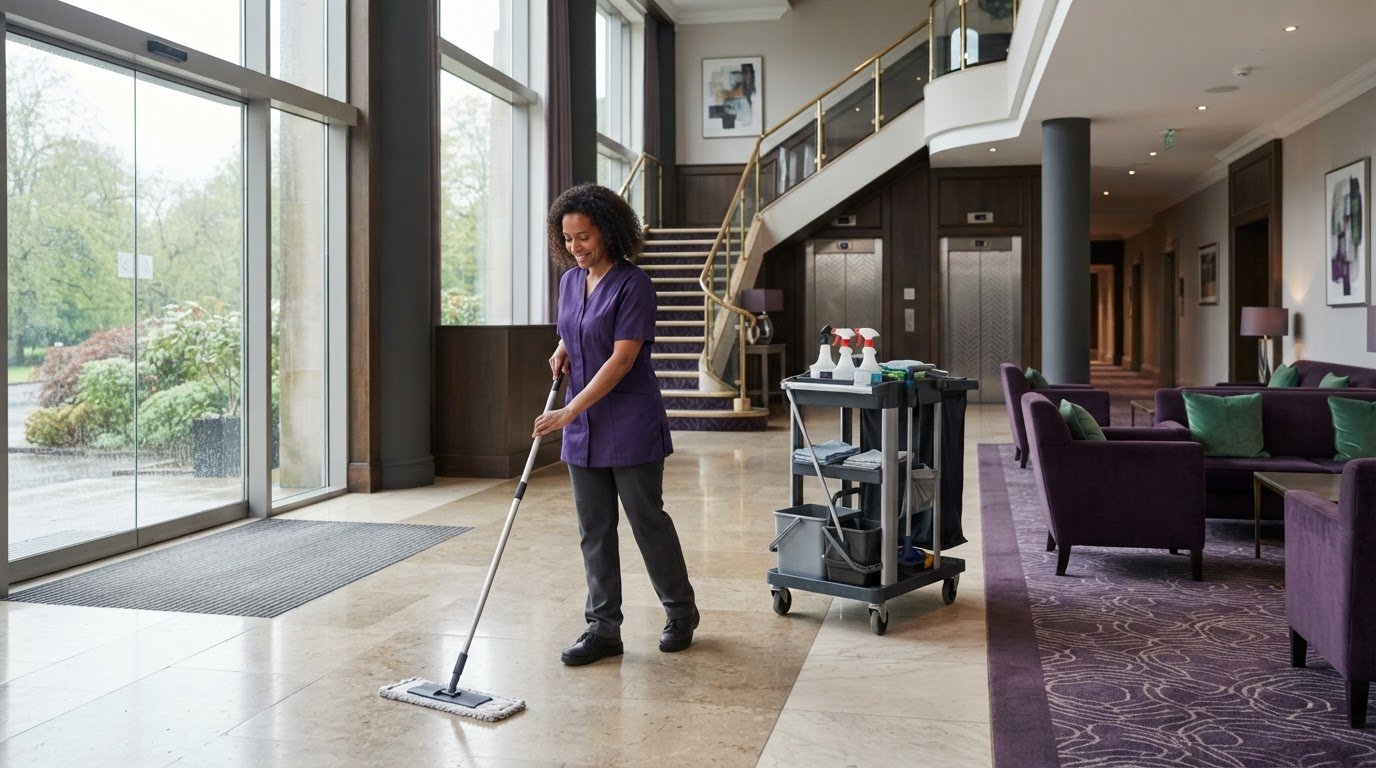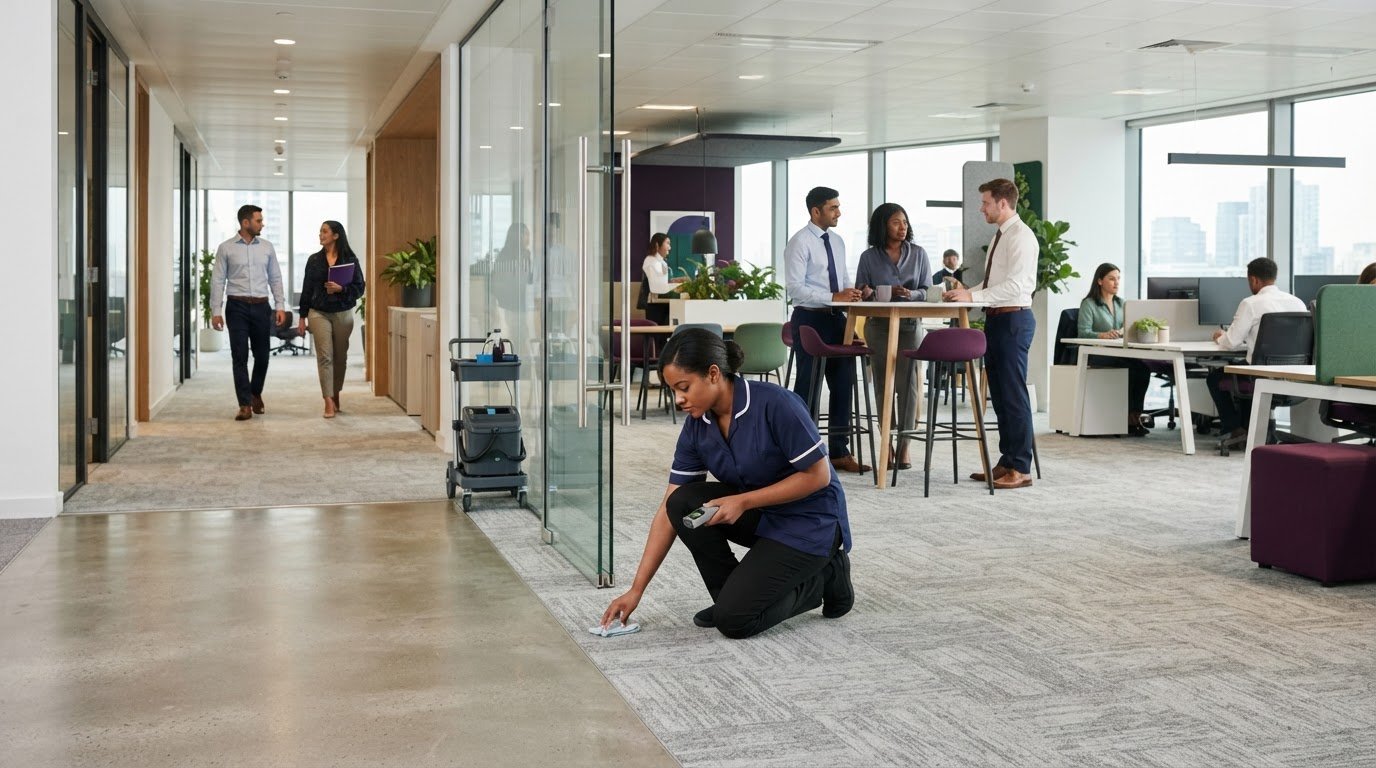
What if a floor that looks clean is still adding friction to the working day? Staff may notice grit underfoot, damp patches or areas that feel neglected. These details can affect comfort and confidence, even if they don’t determine performance. A sensible approach to floor hygiene office productivity looks beyond appearance: well-planned floor care can support a safer, more comfortable workplace, but it can’t guarantee a measurable increase in output.
It’s understandable to be unsure whether routine cleaning is enough, or how to maintain floors without disrupting work or using unsuitable products. The right approach depends on the office, its flooring and how people use each space.
This guide explains the plausible links between floor hygiene and workplace experience, then shows how to build a proportionate routine around footfall and higher-use areas. You’ll learn what to monitor, how to plan cleaning with minimal disruption, and when specialist advice may be appropriate for commercial floor maintenance.
Key Takeaways
- Understand how floor condition can shape comfort, confidence and the everyday office experience without assuming it guarantees higher performance.
- Assess hard floors and carpets according to their condition and use, paying particular attention to entrances, corridors and shared areas.
- Use a repeatable review process to record floor type, location, footfall and recurring issues, then prioritise practical action.
- See how a tailored cleaning schedule and clear quality reviews can support consistent floor hygiene office productivity.
- Recognise when routine care may not be enough and specialist commercial hard-floor cleaning could be appropriate.
How floor hygiene can shape the everyday office experience
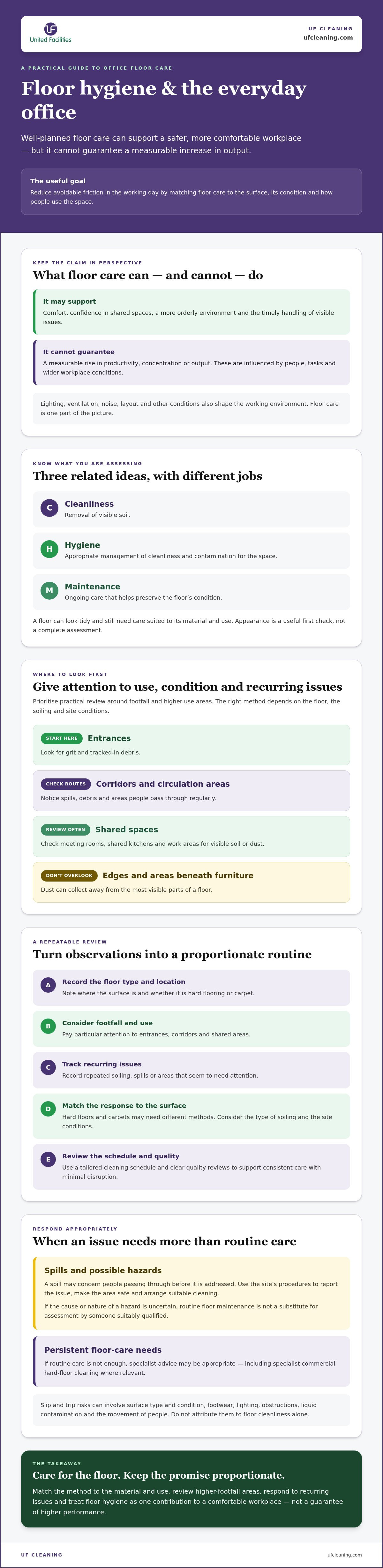
Office floors are part of the environment people encounter throughout the day, from the entrance to meeting rooms and shared kitchens. Their condition can influence first impressions and contribute to whether a workplace feels cared for and comfortable. That contribution matters, but it should be understood proportionately: good floor care may remove avoidable distractions and support the working environment; it can’t guarantee a measurable increase in anyone’s output.
What does floor hygiene mean in a working environment?
Floor cleanliness is the removal of visible soil; floor hygiene is the appropriate management of cleanliness and contamination for the space; floor maintenance is the ongoing care that helps preserve a floor’s condition. This distinction matters because a surface can look tidy while still needing care suited to its material and use.
In practice, staff may notice grit and tracked-in debris near an entrance, a spill in a corridor, or dust collecting along edges and beneath furniture. Each calls for a considered response. A hard floor and a carpet don’t necessarily need the same method. The right routine also depends on footfall, the type of soiling and site conditions. The principles of floor cleaning include choosing methods with the flooring and its purpose in mind.
Appearance is a useful first check, not a complete assessment. A visibly clear floor doesn’t, by itself, confirm every aspect of hygiene or show whether the care method suits the surface.
Why might floor conditions matter to staff?
People form impressions from the details around them. Clean, orderly floors in shared areas may help an office feel more comfortable and well managed, supporting confidence in the space. Visible dirt, lingering odours or an unattended spill can draw attention away from work or prompt someone to report a problem. These are plausible effects on the day-to-day experience, not proof that floor condition alone causes changes in concentration or productivity.
There are practical reasons to respond to obvious issues promptly. A spill can create an immediate concern for people passing through, while debris or ingrained soil may make a frequently used area feel neglected. However, slips and trips depend on several conditions and shouldn’t be attributed to flooring alone.
For office managers considering floor hygiene office productivity, the more useful question is how care can reduce avoidable friction in the working day. Floors are one part of the picture: lighting, ventilation, noise, layout and other workplace conditions also shape how staff experience their surroundings. Attention to floors can support a more reassuring environment without promising a specific performance result.
How floor hygiene may support comfort, safety, and concentration
Floor condition can affect how smoothly people move through shared spaces and how comfortable those spaces feel. A clear circulation route, for example, is less likely to draw attention than one scattered with grit or marked by a spill. These practical details may reduce avoidable interruptions and support confidence in the workplace, but they’re only part of a wider picture.
Floor care can support workplace conditions, but it cannot guarantee productivity gains. A tidy environment may feel more orderly, yet concentration depends on individual preferences, the task at hand and other factors, including noise, lighting and ventilation. What feels distracting to one person may barely register with another.
Comfort and concentration in shared spaces
Consider a route between desks and a meeting room where tracked-in debris is repeatedly visible, or a shared work area where dust gathers around furniture. Staff may find these conditions uncomfortable or feel that the space needs attention. Addressing recurring issues can help maintain a more settled environment, though it shouldn’t be presented as proof that concentration or output will improve. The aim is to remove avoidable friction, not to promise a particular result.
Safety, spill response, and appropriate claims
Spills deserve timely attention because people may pass through the affected area before it’s addressed. A clear reporting route helps staff flag the issue, while an appropriate response can reduce the time it remains unattended. Follow the site’s procedures for making the area safe and arranging suitable cleaning. If the cause or nature of a hazard is uncertain, routine floor maintenance isn’t a substitute for an assessment by someone suitably qualified.
Slip and trip risks are influenced by more than floor cleanliness. The type and condition of the surface, footwear, lighting, obstructions, liquid contamination and the movement of people may all be relevant. Don’t assume that a clean floor is automatically safe, or that a floor alone caused an incident. UK workplaces should refer to applicable UK guidance and their own risk-management procedures. The OSHA general requirements for workplace floors provide a US regulatory reference, not a statement of UK legal requirements.
For a site with recurring hard-floor concerns, a tailored cleaning routine may help address everyday build-up. Persistent or unusual conditions may warrant specialist assessment. Organisations reviewing their requirements can explore commercial office floor cleaning as one option.
Which office floor conditions deserve attention first?
Start with what you can observe, then compare each area’s condition with how it’s used. An entrance that collects tracked-in soil may need attention sooner than a quiet room, while a carpet with a persistent mark may call for a different response from a hard floor that looks dull. This practical approach helps managers set priorities without assuming every surface needs identical care.
Hard floors and carpets need different care
Floor material affects which routine methods are suitable and whether periodic specialist work may be needed. On hard floors, look for tracked-in dirt, debris at edges and a dull or uneven appearance. On carpet, note visible soil, flattened areas or staining that remains after routine cleaning. These are prompts to investigate, not a diagnosis. The flooring type, manufacturer guidance and site conditions should inform the next step. If ordinary upkeep isn’t resolving a recurring issue, consider whether specialist advice is appropriate.
Footfall and high-use zones change priorities
Entrances and circulation routes often receive more passing traffic, so they can accumulate tracked-in soil more readily than low-use rooms. Kitchens and other shared areas may need attention when spills, crumbs or visible build-up are observed. Rather than assigning every zone the same frequency, record actual use and recurring conditions, then review priorities as they change. This gives floor hygiene office productivity planning a practical basis without assuming a fixed schedule suits every office.
Use the table as a starting point for assessment, not a substitute for site-specific advice. Set priorities according to the observed condition and how the space is used.
| Area | Observed condition | Priority | Next action |
|---|---|---|---|
| Entrance | Tracked-in soil or debris near the doorway | High if regularly used or visibly soiled | Record where build-up occurs and review the current care routine |
| Corridor | Debris or dulling along the main route | Based on footfall and extent of soiling | Check the full route, including edges and junctions |
| Kitchen or shared area | Spills, crumbs or recurring marks | Prompt attention where the issue is present | Follow the site’s spill procedure and note repeat locations |
| Low-use room | Little visible soil or no recurring issue | Routine review | Maintain checks and adjust if use or condition changes |
Set cleaning intervals according to material, footfall and conditions, rather than relying on an unsupported universal frequency. Review observations over time and adjust the plan if particular locations repeatedly show soil or wear.
How to assess and improve office floor hygiene
A consistent review process turns general impressions into practical decisions. Rather than relying on a fixed cleaning interval, use site observations to decide where care is needed, whether the current routine is working and what needs follow-up. This makes floor hygiene office productivity planning more proportionate, without assuming every area or surface has the same needs.
A simple floor hygiene inspection routine
Choose representative areas, such as an entrance, a main corridor, a shared kitchen and a lower-use room. Inspect them at consistent times so changes are easier to spot, and record observations in a simple log. Include the floor type, location, visible condition, approximate footfall and any recurring concerns. Keep notes factual: “tracked-in debris near entrance” is more useful than a general comment that an area looks poor.
Use a repeatable sequence:
- Observe: Check for visible soil, spills, staining, dulling or debris.
- Record: Note where and when the issue appears, including whether it has occurred before.
- Prioritise: Consider the condition, how the area is used and whether follow-up is needed.
- Act: Arrange suitable routine care or escalate persistent and specialist concerns.
- Review: Check whether the action addressed the issue and update the routine if it recurs.
If cleaning is delivered by a provider, compare the agreed task expectations with the work completed and any documented quality checks. UF Cleaning describes real-time quality controls through the Taskbe platform. Confirm the current scope of reporting with the provider before relying on particular measures or features.
Match maintenance to the site and its users
A useful routine reflects how the office actually operates. Consider occupancy patterns, busy circulation routes, floor materials, access requirements and times when cleaning could interrupt work. Select products and methods suitable for the specific surface, and check their compatibility against relevant flooring guidance before use. If conditions change, the care plan may need to change too.
Review observations after a layout change, seasonal shifts that affect tracked-in soil, or repeated quality concerns. If staining persists or routine methods appear unsuitable, seek advice from a provider with relevant commercial floor-care expertise rather than applying a stronger product or technique without checking.
For support with a tailored office cleaning routine, discuss commercial office cleaning with UF Cleaning.
Building consistent floor hygiene into workplace cleaning
Floor care is most reliable when it forms part of a wider commercial cleaning plan, rather than being treated as an occasional response to visible dirt. A site-specific schedule can account for different zones, floor materials and observed needs, with suitable timings chosen to limit disruption to staff. Clear expectations help everyone understand what should be maintained and how recurring concerns should be raised.
What a consistent floor care plan can include
A useful plan sets out which areas need attention, the appropriate care for each surface and how completed work will be reviewed. For example, an entrance with regular tracked-in soil may need a different approach from a carpeted meeting room or a lower-use corridor. Task specifications should be clear enough to guide delivery while leaving room to adjust the routine when actual site conditions change.
Reporting routes matter too. Staff should know how to flag a spill or recurring issue, and managers should be able to compare those reports with agreed tasks and documented quality checks. UF Cleaning describes real-time quality monitoring through the Taskbe platform; confirm the current scope of reporting before relying on particular features or measures. Its recurring cleaning service includes eco-friendly products, though product suitability should still be considered in relation to the floor and the task.
When to seek professional commercial floor care
Routine office cleaning can help manage day-to-day soil, but it may not resolve persistent staining, worn finishes or repeated concerns. If an issue remains despite appropriate routine care, a professional assessment can help determine whether the surface needs a different method. Specialist hard-floor cleaning or restoration is distinct from regular upkeep, and the right option depends on the floor’s material, condition and use.
For managers considering floor hygiene office productivity, a consistent plan offers a practical way to maintain shared spaces and make care more visible, without implying a guaranteed change in performance. Review the arrangements periodically, particularly when the layout, occupancy patterns or observed floor conditions change. Clear specifications and an established feedback process can help keep the routine proportionate and responsive.
If you’re reviewing your workplace cleaning arrangements, you can Discuss a tailored commercial cleaning requirement with UF Cleaning.
Make floor care a considered part of your workplace routine
Floor hygiene can support a more comfortable, orderly office, but it shouldn’t be treated as a guarantee of improved output. The practical approach is to observe how different areas are used, record recurring conditions and adjust care to suit the flooring and site. Clear task expectations and regular quality reviews help keep the routine responsive.
That’s the measured link between floor hygiene office productivity: appropriate floor care can reduce avoidable distractions and support the workplace experience, while performance also depends on many other factors. If routine attention isn’t resolving persistent floor concerns, specialist commercial hard-floor cleaning may be worth considering.
UF Cleaning has served organisations since 2010 and offers commercial hard-floor cleaning, with real-time quality controls through Taskbe. If you’re reviewing your current arrangements, discuss a tailored commercial cleaning requirement with UF Cleaning. A consistent, well-matched plan is a practical step towards a more reassuring environment for staff.
Frequently Asked Questions
Can better floor hygiene improve office productivity?
Better floor hygiene may support office productivity by helping shared spaces feel orderly and comfortable, and by reducing avoidable distractions such as visible debris or unattended spills. It doesn’t prove staff will work faster or produce more. Concentration and output are influenced by many factors, including the task, individual preferences, lighting and noise. Treat floor care as one considered part of the working environment, not a guaranteed route to measurable performance gains.
How often should office floors be cleaned?
There’s no single cleaning frequency that suits every office. Set a routine according to the flooring material, footfall, occupancy patterns and the amount of soiling observed. An entrance with frequent tracked-in dirt may need different attention from a lightly used room. Record recurring issues and review whether the current schedule addresses them. Adjust it when use or conditions change, rather than applying a fixed interval without considering the site.
What is the difference between floor cleaning and floor hygiene?
Floor cleaning is the removal of soil, debris and other unwanted material from a surface. Floor hygiene is the broader, appropriate management of floor cleanliness in relation to the space, its use and observed conditions. It includes choosing suitable care and responding to recurring issues. Floor maintenance refers to ongoing care intended to keep the surface in suitable condition. A floor that looks clean is a useful sign, but appearance alone doesn’t confirm every aspect of hygiene.
Can dirty office floors affect staff wellbeing?
Visible dirt, lingering odours or spills may make a workplace feel less comfortable or reassuring, and could distract some staff. However, floor condition alone can’t be assumed to cause a change in wellbeing or health. People’s experience is also shaped by factors such as ventilation, lighting, noise and the nature of their work. Responding appropriately to observed floor issues can support a more orderly environment, without claiming that cleaning will deliver a specific health outcome.
Which office floor areas should be checked most often?
Give particular attention to areas where observed use or soiling warrants it, such as entrances, busy corridors, kitchens and other shared spaces. These zones may collect tracked-in dirt, debris or spills, but their condition will vary between workplaces. Include lower-use areas in routine reviews too. Note where and when issues appear, then use those observations to set priorities. Check routes and shared areas after changes in occupancy, layout or use.
Do carpets and hard floors need different cleaning routines?
Yes. Carpet and hard flooring have different surfaces, so suitable routine care and periodic specialist work may differ. Check for visible soil, debris, staining or changes in appearance, then refer to relevant flooring guidance before selecting products or methods. Don’t assume a method suitable for one surface will work for another. If routine care doesn’t resolve persistent staining or concerns, seek advice from a commercial cleaning provider with relevant floor-care expertise.
How can an office manager check whether floor cleaning is effective?
Compare the agreed cleaning tasks with the condition of representative areas after work is completed, and record recurring concerns. Note the floor type, location, visible condition and footfall patterns so changes can be assessed over time. Review reports and documented quality checks with the cleaning provider, clarifying what the checks cover. UF Cleaning uses real-time quality controls through Taskbe; ask the provider about the current scope of reporting rather than assuming particular features.