Outsourcing is not automatically a saving, but it can align operational support more closely with demand. Hospitality outsourcing companies in the UK can provide extra capacity during busy periods and take on recurring tasks. The effect on costs depends on the work transferred, the service scope and how demand changes.
It is understandable to focus on the headline cost, but a useful comparison considers the full cost of delivering work in-house alongside the outsourced scope, including management time and cover. This article explains how outsourcing can support seasonal peaks, which factors shape potential savings and what to assess when considering service quality and operational risks. It also distinguishes tasks that can be delegated from responsibilities that remain with the hospitality business, helping you decide whether outsourcing suits your operation rather than treating it as a universal solution.
Key Takeaways
- Map seasonal demand against the tasks that need extra capacity, then decide which work can be scaled without disrupting service.
- Use the reported pressure of labour costs on hospitality turnover to frame a closer review of staffing and operating priorities.
- Set clear service boundaries, quality measures and accountability before outsourcing, so operational risks are easier to manage.
- Compare outsourced options by service type and scope, then focus on support that addresses a specific pressure in your operation.
Scaling support for peak seasons
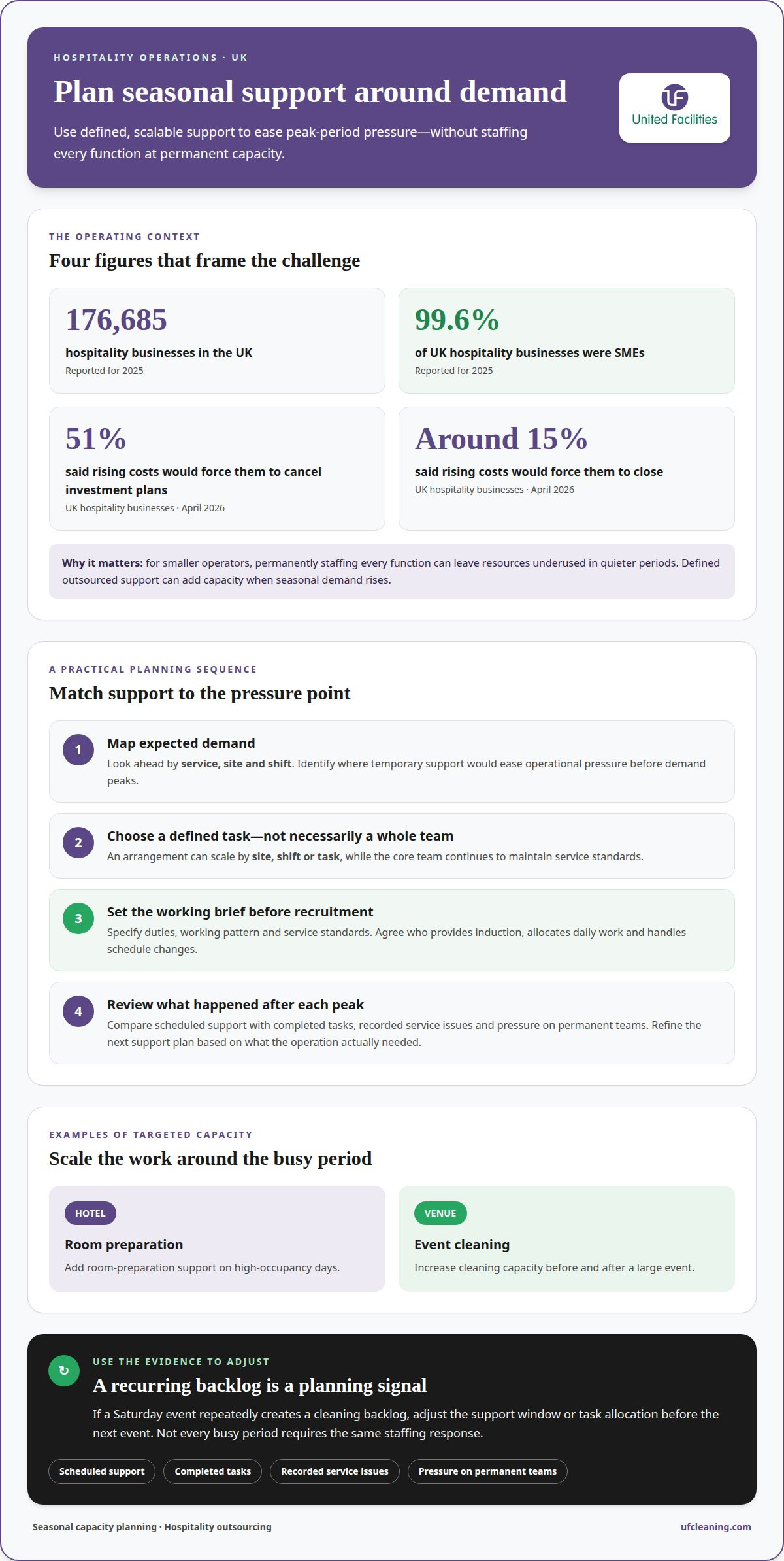
The UK had 176,685 hospitality businesses in 2025, spanning venues with different trading patterns. In the same year, SMEs accounted for 99.6% of UK hospitality businesses. For smaller operators, staffing every function at permanent capacity can leave resources underused during quieter periods. Outsourcing can provide defined support when seasonal demand increases.
In April 2026, 51% of UK hospitality businesses said rising costs would force them to cancel investment plans. Around 15% said rising costs would force them to close. These pressures make advance planning more useful than reactive recruitment. Map expected demand by service, site and shift, then identify where temporary support would ease operational pressure.
An outsourced arrangement can scale by site, shift or defined task without replacing an entire team. For example, a hotel could add room-preparation support on high-occupancy days, while a venue could increase cleaning capacity before and after a large event. Hospitality outsourcing companies in the UK can structure support around defined workloads, helping managers protect the guest experience while core teams maintain service standards.
For seasonal or high-volume hiring, set out the duties, working pattern and service standards before recruitment begins. A clear task list aligns temporary staffing with actual demand instead of simply adding headcount. Agree who provides induction, allocates daily work and handles schedule changes. This helps seasonal workers understand their responsibilities from the outset.
Review the plan after each peak period. Compare scheduled support with completed tasks, recorded service issues and pressure on permanent teams. If a Saturday event repeatedly creates a cleaning backlog, for example, adjust the support window or task allocation before the next event. Regular reviews help refine capacity without assuming every busy period requires the same staffing response.
Hospitality outsourcing costs and operational savings
Labour pressure makes payroll and rota analysis essential for hospitality businesses. In November 2025, 55% said labour costs were affecting turnover. In April 2026, 64% said rising costs would force job cuts, while 42% anticipated reducing trading hours. These figures show why cost reviews should examine staffing patterns alongside outsourced service costs.
Start with a defined review period and compare each rota with actual demand. Track payroll against scheduled hours, overtime, absence cover and quiet periods. For example, a restaurant can compare staffing on busy service days with quieter shifts, then identify where hours consistently exceed operational needs. This gives managers a clearer basis for adjusting rotas, outsourcing a task or keeping it in-house.
Outsourcing can shift the balance between fixed overhead and work commissioned as needed. Potential savings depend on service scope, frequency, site requirements and management time. Compare the complete arrangement, including internal supervision and any duties retained by your team, rather than treating the supplier’s invoice as the only cost. A cleaning schedule, for instance, should reflect venue use and agreed tasks.
How do leading UK hospitality outsourcing companies compare by services, locations and client types? Compare each provider’s service scope, regional coverage and experience with the relevant operation, such as a hotel, restaurant or event venue. These distinctions matter more than a broad ranking when assessing operational fit.
Which UK hospitality outsourcing companies serve hotels, restaurants, pubs and venues? Providers differ in their services and client focus, so match the task to the setting. For hotels and venues, UF Cleaning’s Hotel Management and Events & Venues Cleaning support relevant operational needs.
Which companies operate across England, Scotland, Wales and Northern Ireland? Compare coverage separately for each nation and site, since a stated UK-wide footprint should match the locations your operation needs. For venue cleaning needs, Events & Venues Cleaning is one relevant service to consider.
Risks and mistakes when choosing an outsourcing provider
A poorly defined service can create gaps between a venue’s standards and the provider’s work. Before comparing proposals, document each task, location, service window and expected outcome. For example, specify which areas a hotel cleaning schedule covers, who records completion and how missed tasks are escalated. Clear boundaries reduce duplicated work and make performance easier to assess.
What UK employment laws apply when outsourcing hospitality staff, including TUPE and the National Minimum Wage? Assess whether TUPE applies to the proposed staff transfer and include National Minimum Wage requirements in the pay review. Consider the relevant employment arrangements and current rules before responsibilities change.
Another risk is choosing a provider without relevant hospitality experience. Ask for evidence of work in a comparable setting, such as a hotel, pub or event venue, and assess whether its operating practices match your requirements. A polished proposal alone does not show how a provider manages access, changing schedules or service standards during a busy shift.
What are the benefits and risks of outsourcing hospitality operations in the UK? Outsourcing can provide defined operational support and specialist processes, while risks include unclear accountability, inconsistent standards and disruption during transition. A written scope, named contacts and agreed performance measures help maintain smooth delivery and clarify where improvements may be needed.
How can a UK hospitality business tender for and transition to an outsourcing provider? Prepare a tender covering tasks, sites, service periods and quality expectations, then compare proposals against the same criteria. Include a transition plan for staff communication, site access, equipment, reporting and responsibility for unresolved tasks. This makes bids easier to evaluate consistently.
Before the start date, test the reporting route with a practical example, such as a missed room clean or an issue in an event space. Agree who records the problem, who responds and how completion is confirmed. Review early performance against the written standards, then adjust task instructions if the venue’s needs differ from the original scope.
What hospitality services can UK companies outsource, such as catering, cleaning, security and staffing?
UK hospitality businesses can outsource defined operational tasks without transferring an entire function. A hotel might arrange room cleaning, while a pub could outsource selected maintenance or event support. Catering, security, staffing and cleaning are distinct service areas, each requiring a clear scope. Specify the site, tasks, service times and reporting route before comparing options.
Cleaning support can cover guest-facing and back-of-house areas, depending on the venue’s needs. An events venue, for example, may need a planned clean before opening and after guests leave. A hotel may prioritise bedrooms and shared spaces, while a restaurant could focus on dining and service areas. Specify the areas, expected finish and process for reporting missed work.
Catering arrangements may cover food preparation, service or a specific event requirement. Define menu responsibilities, the service period and coordination with the venue team. Security support may involve access management or event stewarding, with responsibilities agreed for each entrance or area. Staffing support can focus on particular shifts or functions rather than replacing the permanent team.
Choose a service by identifying the operational pressure first. If room turnaround is inconsistent, assess cleaning tasks and scheduling. If an event needs extra support, specify guest arrival patterns and venue access. Then compare proposals against the same requirements, including supervision, communication and how completed work is recorded. This keeps the decision focused on a defined outcome.
Some tasks may be better retained in-house, especially where they rely on close coordination with the venue’s daily service. A restaurant could outsource periodic cleaning while keeping meal service under its own management. For venues assessing external cleaning support, explore venue cleaning support as a practical next step. Match the scope to the venue, not simply to a broad service label.
Outsourcing can also cover accounting, alongside operational services such as cleaning or staffing. UK hospitality businesses should review outsourced accounting services routinely after the transition to identify opportunities for improvement. A review can consider the agreed scope, communication and reporting route, keeping the arrangement aligned with business needs.
UF Cleaning: Office Cleaning London
UF Cleaning supports hospitality operations nationwide with commercial cleaning and facilities care. Professional Housekeeping and Hotel Management Support can assist hotel operations across the UK, while Carpet, Window & Floor Care addresses floor upkeep in commercial environments.
Consider these services when cleaning demands take time away from core teams or your establishment needs structured housekeeping support. A defined scope and schedule help align the work with your operation.
To discuss your requirements with one of the leading hospitality outsourcing companies UK wide, contact UF Cleaning.
Make your next step operationally clear
Before deciding, prepare a short brief describing what your operation needs to achieve. Include the outcomes that matter most to your team, so you can assess proposals against clear priorities rather than broad promises.
When assessing hospitality outsourcing companies in the UK, consider how each proposal supports those outcomes and fits your operating approach. A focused brief keeps discussions practical and helps clarify the next decision.
UF Cleaning can discuss the support your operation is considering and the requirements involved.
Contact UF Cleaning to discuss support. A clear starting point can help you move forward with confidence.
Frequently Asked Questions
Which companies provide hospitality outsourcing services in the UK?
UK hospitality outsourcing is provided by specialists, with different firms focusing on areas such as food service, security, staffing or cleaning. UF Cleaning provides commercial cleaning and facilities support, including hospitality-related services. The right category depends on the function being outsourced: a hotel seeking housekeeping support has different requirements from a venue arranging event catering or security.
What are typical costs and pricing models for hospitality outsourcing in the UK?
There is no single standard price for hospitality outsourcing. Recurring commercial cleaning can be arranged through a service agreement, while specialist projects can be quoted separately. Hospitality and hotel management support may be priced by room volume or dedicated staffing hours. UF Cleaning provides a free, no-obligation quotation based on the building, work required, cleaning hours, frequency and service arrangements. The quote sets out the agreed scope and whether materials are included or charged separately.
What should UK businesses check when choosing a hospitality outsourcing provider?
Check how the provider employs and vets its staff and records service delivery. For cleaning services, UF Cleaning uses directly employed, vetted teams and quality checks with client feedback. Its Taskbe platform provides real-time activity updates, staff and rota visibility, and fast issue reporting. These details help you understand who carries out the work and how concerns are handled.
How do leading UK hospitality outsourcing companies compare by services, locations and client types?
Compare providers by service scope, coverage and experience with the relevant operation, such as a hotel, restaurant or event venue. These distinctions matter more than a broad ranking when assessing operational fit.