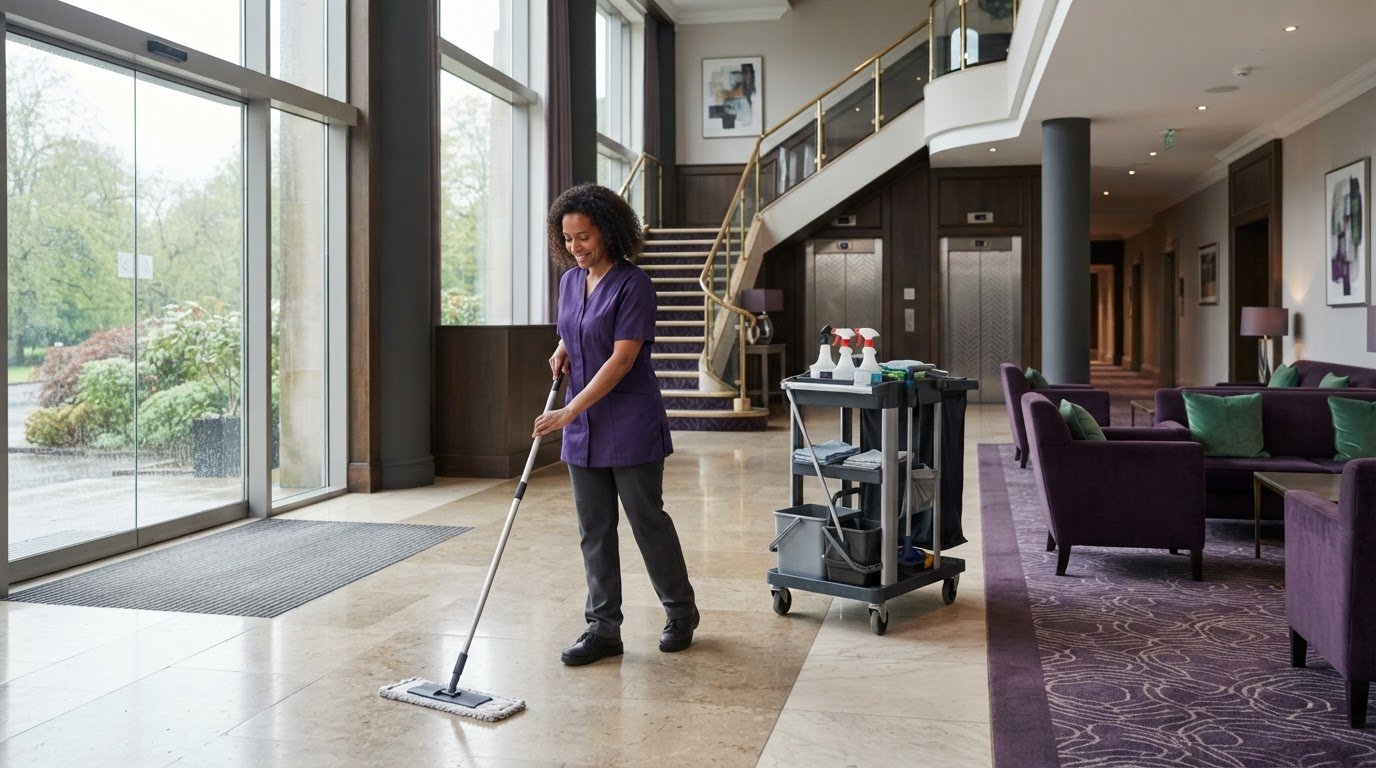
A spotless guest room cannot compensate for an overlooked entrance or corridor. Hotel public area cleaning keeps shared spaces presentable, hygienic and ready for use. Duties include vacuuming carpets, dusting, mopping hard floors and emptying bins in busy areas such as lobbies, corridors, lounges, restaurants and bars.
Guests and staff notice these spaces throughout the day, especially where people gather or pass through frequently. A consistent routine helps create a welcoming impression and keeps shared areas orderly and comfortable.
This guide explains the main duties of a public area cleaner, the hotel spaces they maintain and how daily, weekly and periodic tasks fit together. It also covers practical ways to plan cleaning around guest activity and hotel operations.
Key Takeaways
- Public area cleaning duties should reflect footfall, surfaces and how each space is used.
- Regular attention to lifts, stairs and handrails helps keep busy routes clean and presentable.
- Entrance glass, doors, mats and outdoor seating all contribute to the arrival experience.
- A clear schedule separates routine upkeep from deeper cleaning and helps teams maintain standards as hotel activity changes.
- Checking areas during the day helps staff spot spills, litter and untidy furniture between scheduled tasks.
What are the primary responsibilities of a public area cleaner?
Public area cleaners maintain shared hotel spaces, balancing visible presentation with practical upkeep. Their tasks should follow how guests and staff use each area, from breakfast rooms to entrances and walkways. A useful plan identifies the surfaces and touchpoints in each space, then sets out when they need routine attention and when deeper cleaning is due.
Public-area schedules and presentation
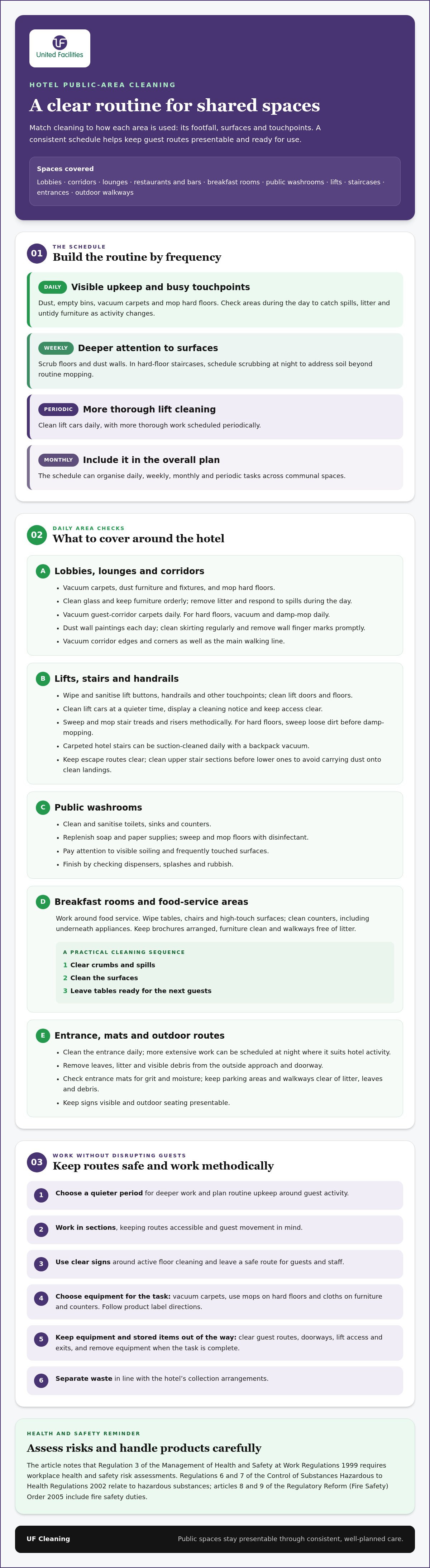
A cleaning schedule organises daily, weekly, monthly and periodic tasks across communal spaces. Daily duties may include dusting, emptying bins, vacuuming carpets and mopping hard floors; weekly work can include scrubbing floors and dusting walls. Checks during the day help teams respond to changing footfall and keep lobbies, corridors and lounges orderly.
Breakfast rooms need attention around food service. Wipe tables, chairs and high-touch surfaces, then clean counters, including underneath appliances. A practical sequence is to clear crumbs and spills first, clean the surfaces next, and leave tables ready for the next guests. Neatly arranged brochures, clean furniture and litter-free walkways also help the room look cared for.
Toilets and public washrooms
Public washroom cleaning includes cleaning and sanitising toilets, sinks and counters, as well as replenishing soap and paper supplies. Sweep and mop floors with disinfectant, and pay particular attention to visible soiling and frequently touched surfaces. Include a final check for empty dispensers, splashes and rubbish so the facilities are ready for continued guest use.
Hotel cleaning staff need to work within workplace health and safety requirements. Regulation 3 of the Management of Health and Safety at Work Regulations 1999 requires workplace health and safety risk assessments. Regulations 6 and 7 of the Control of Substances Hazardous to Health Regulations 2002 set out requirements relating to hazardous substances, while articles 8 and 9 of the Regulatory Reform (Fire Safety) Order 2005 include fire safety duties, according to UK Parliament.
Choose equipment for the surface and task: vacuum carpets, use mops on hard floors, and use cloths for furniture and counters. Select cleaning products for the surface being treated and follow the label directions. Keep equipment organised and out of guest routes, doorways and exits.
To minimise disruption, schedule deeper work for quieter periods and maintain regular upkeep during the day. Clean in sections, keep routes accessible and use clear signs around active floor cleaning. Keep waste separated in line with the hotel’s collection arrangements. For external cleaning support, agree the tasks, frequency, access arrangements and operating hours in advance, so the plan reflects how the property runs.
Parking areas and walkways also need attention. Remove litter, leaves and debris, and keep signs visible. The cost of cleaning depends on the building, the work required, cleaning hours, frequency and service arrangements. UF Cleaning provides a free, no-obligation quotation based on those requirements.
Elevators, stairs and handrails
Lift cars, staircases and corridors connect many of a hotel’s busiest shared spaces. A thorough routine covers both visible dirt and frequently touched surfaces. A practical lobby and corridor checklist includes vacuuming carpets, dusting furniture and fixtures, mopping hard floors, cleaning glass, and sanitising lift buttons and handrails.
Clean lift cars daily, with more thorough work scheduled periodically. Choose a quieter time, display a cleaning notice and keep access clear. Wipe and sanitise buttons, handrails and other touchpoints, then clean lift doors and floors. This sequence helps staff work methodically without obstructing guest movement.
Staircase cleaning needs to cover both treads and edges. Sweep and mop the treads and risers, working methodically so dust does not fall onto sections that have already been cleaned. Work during a quieter period and keep escape routes clear of linen, spare beds and stored items. Carpeted hotel staircases can be suction-cleaned daily with a backpack vacuum.
Hard-floor staircases need a different routine from carpeted ones. Sweep loose dirt before damp-mopping to avoid spreading grit across the surface. Weekly scrubbing, scheduled at night, addresses accumulated soil beyond routine mopping. Use clear signs during wet-floor cleaning and leave a safe route for guests and staff. Plan the sequence around people moving between floors.
Clean corridors along their full length, not only down the centre. Vacuum guest corridor carpets daily, and vacuum and damp-mop hard floors daily. Dust wall paintings each day, clean skirting regularly and remove finger marks from walls promptly. These details are easy to miss, but remain within guests’ direct line of sight.
Coordinate work across connected spaces. Clean upper stair sections before lower ones, and avoid carrying dust onto recently cleaned landings. In carpeted corridors, vacuum edges and corners as well as the main walking line. Keep equipment clear of doors, lift access and escape routes, then remove it when the task is complete.
For hotels coordinating these routines with wider operations, hotel management support can form part of an organised approach. UF Cleaning provides hotel cleaning and housekeeping, including room care and replenishment, as well as hotel management support. A consistent plan helps teams attend to lift touchpoints, stair surfaces and corridor details without overlooking smaller tasks.
Entrance, exterior seating and doormats
The entrance sets the first physical impression, from the approach to the lobby floor. Clean it daily, with more extensive entrance work scheduled at night where that suits the hotel’s activity. This gives the team time to clear tracked-in dirt, attend to door surfaces and prepare the arrival route before daytime traffic builds.
Start with the outside approach, removing leaves, litter and visible debris from the doorway. Check the entrance mat for grit, moisture and curled edges, then clean it according to its material. A mat that lies flat and catches dirt helps reduce what reaches the floors beyond the threshold. Keep the doorway and walking route clear while working.
Clean lobby doors and knobs daily. Wipe handles and other visible contact points, then check door edges and frames for marks. Glass entrance doors, windows and frames also need attention. Work across the glass in a consistent pattern so fingerprints and streaks do not stand out against the lobby lighting.
Pay close attention to the point where outdoor surfaces meet indoor flooring. Remove loose grit before mopping, as grit can spread across a damp floor. Clean the threshold, the mat’s edges and the adjoining floor rather than stopping at the centre of the entrance. If guests are still using the entrance, work in a manageable section and leave a clear route around it.
Exterior seating and tables are part of the guest arrival area. Wipe them down, paying attention to visible marks and debris. Check beneath tables for litter, then return chairs neatly after cleaning. This leaves the seating ready for guests, rather than merely clean on its upper surfaces.
Weather affects the type of soil brought to the doorway. Rain can leave damp footprints, while dry conditions may bring dust or grit onto mats and floors. Respond to what is present: remove loose debris first, address damp marks on the floor, then inspect the mat again. Do not leave visible dirt or wet trails unattended.
Finish with a check from outside to inside. Inspect the approach, mat, glass, door knobs, threshold and lobby floor in sequence. Confirm that exterior tables are wiped and chairs are orderly. This final pass catches details that can be missed when separate tasks are completed without reviewing the whole arrival space.
Lift doors, controls, carpets and ventilation
Lift cars and lobby surfaces need a routine that covers both touchpoints and surrounding finishes. Daily cleaning, prompt stain removal and periodic deeper work help keep these details presentable.
Lift doors and controls
Lift-door cleaning covers visible marks on doors and the surfaces guests touch when calling a lift or travelling between floors. Clean lift doors as part of the daily routine, then wipe and sanitise buttons and handrails. Schedule more thorough work periodically, choosing a quieter time and displaying a cleaning notice. This keeps the task orderly and makes it clear that cleaning is under way.
High-touch surface disinfection
High-touch surface cleaning means attending to frequently handled points, such as lift buttons, handrails, guest card machines and check-in tablets. Clean and sanitise these surfaces as part of routine care, using a suitable product and following its label directions. A deliberate sequence helps prevent missed touchpoints and avoids using the same cloth across unrelated surfaces.
Vacuum hotel guest corridor carpets daily, and inspect lobby carpets around furniture, seating and lift thresholds, where crumbs and grit can collect. Remove visible stains from lobby carpets and upholstery promptly, rather than allowing them to detract from the room’s appearance. For a larger mark, use a method suited to the material.
Hard floors around lift doors need attention too. Remove loose dirt before damp-mopping, especially where foot traffic carries grit from corridors. Work around the lift entrance without blocking it, and leave the surface clear of cleaning equipment when finished. A clean threshold makes the transition between the lift car and lobby feel well maintained.
Ventilation grilles are another visible detail in lobbies and corridors. Include accessible grille faces in routine dusting when they show a build-up, alongside nearby furniture, fixtures and glass. Use a suitable tool that captures dust rather than scattering it onto recently cleaned surfaces. Limit this task to accessible surfaces and leave the ventilation system itself undisturbed.
For a consistent finish, organise the sequence around the area’s use: attend to dust first, then floors, then touchpoints. Recheck lift buttons, handrails and door panels before leaving. If guests need the lift during cleaning, keep access clear and use a notice to indicate active work. This order addresses visible marks without turning a busy lobby into an obstacle course.
Purpose and importance of hotel public-area cleaning
Clean shared spaces shape how guests experience a hotel beyond their rooms. A tidy lobby, clear corridor and orderly lounge create a positive impression, while marks or clutter can undermine that welcome. Consistent cleaning helps uphold the hotel’s standards and contributes to the guest experience because these spaces remain visible throughout a stay.
The value is practical as well as visual. Guests use corridors to reach rooms, lifts to move between floors and reception areas to check in. A clean route makes these shared spaces feel ready for use. Staff also rely on orderly work areas, especially where guest movement intersects with daily hotel operations.
Consistency matters because public spaces see changing patterns of use. A lobby may be quiet early, then busy during arrivals; a breakfast room shifts from meal service to clearance and preparation. A schedule gives staff a clear structure, while checks during the day help identify spills, litter or untidy furniture between routine tasks. This combination helps the team respond to actual conditions.
Prioritising work by use makes routines more effective. Focus first on areas with frequent contact or visible soil, such as reception touchpoints, lift controls and entrance floors. Then review less prominent details, including corridor skirting or dust on wall paintings. This order helps teams address immediate presentation issues without losing sight of thorough upkeep.
Some spaces need attention for reasons beyond appearance. Hotel swimming pools should be cleaned and disinfected regularly for hygiene. Pools that are not cleaned regularly may become carriers of water-borne disease. A consistent pool-cleaning routine is therefore an important part of maintaining the facility, rather than an occasional response to visible debris.
Public-area care also supports smooth hotel operations. Clear routes help guests move through the building, while clean breakfast-room tables allow service to continue efficiently. For banquets, cleaning and arranging the hall before and after each function prepares the room for its next use. Schedules should reflect each area’s purpose rather than apply an identical routine everywhere.
Treat cleaning as part of the guest journey. Review the route from entrance to reception, lifts, corridors and shared facilities, then match routine tasks to how each space is used. Hotels seeking coordinated support for these operations can explore hotel management support as part of a considered facilities approach.
UF Cleaning: Office Cleaning London
UF Cleaning provides Hotel Cleaning & Housekeeping and Hotel Management Support for organisations across the United Kingdom seeking help with hotel operations and shared-space upkeep. Housekeeping covers room care and replenishment, while hotel management support can include operational support and linen hire. The service plan can align guest-facing cleaning with wider operational routines.
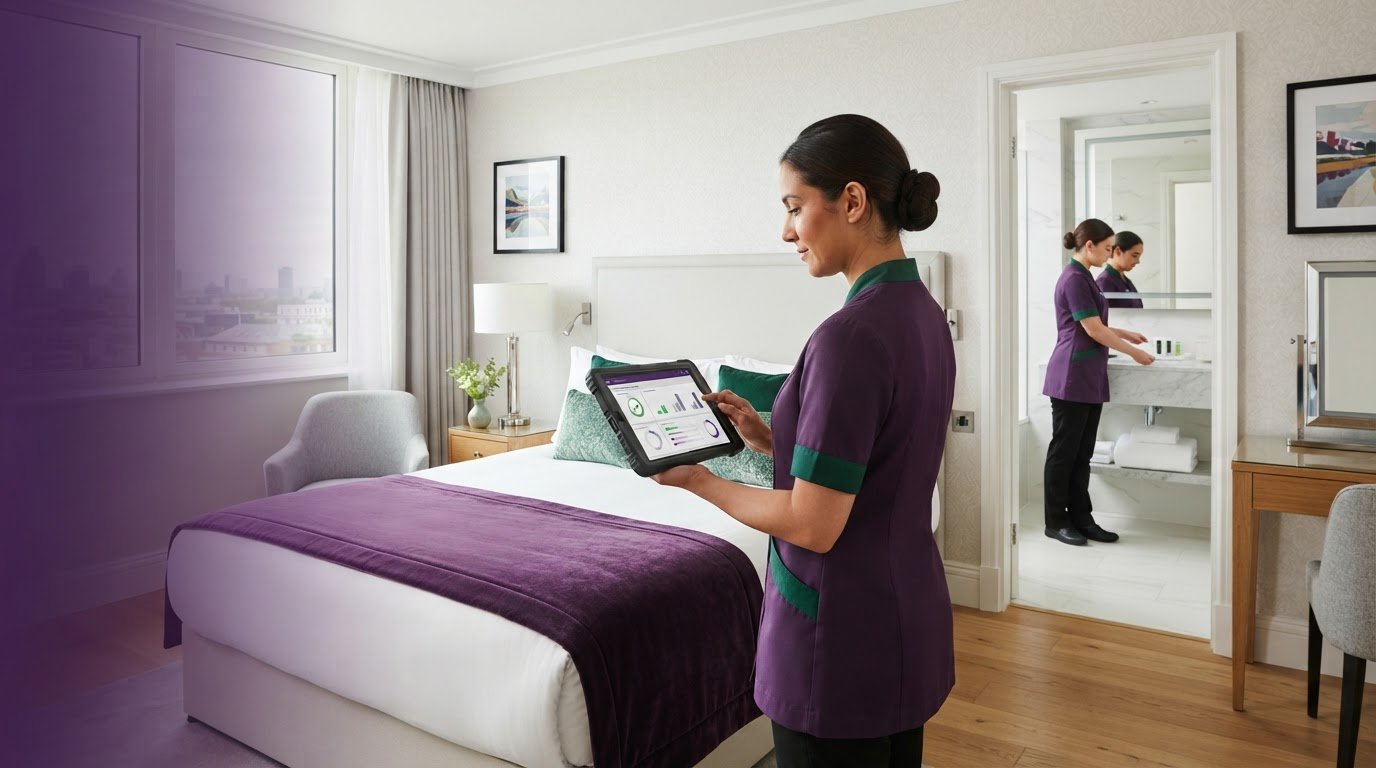
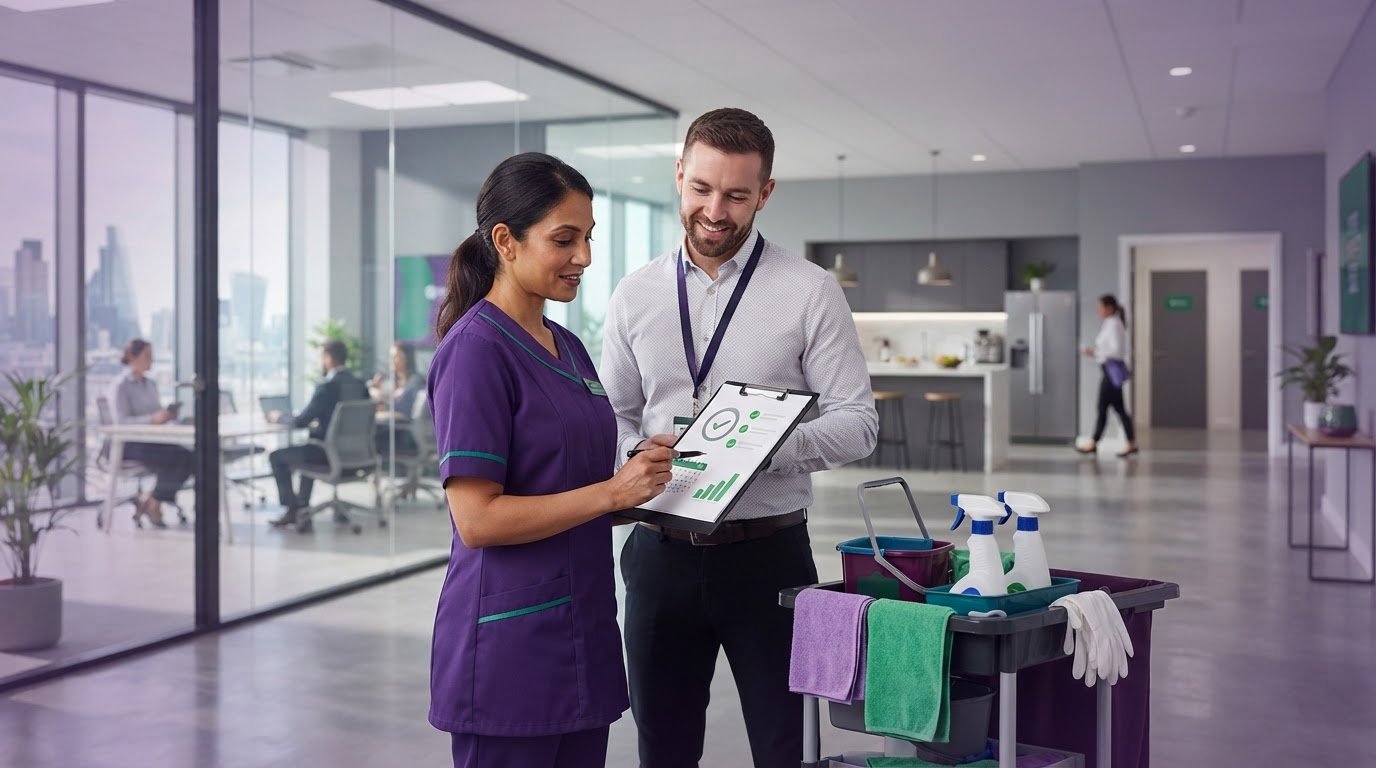
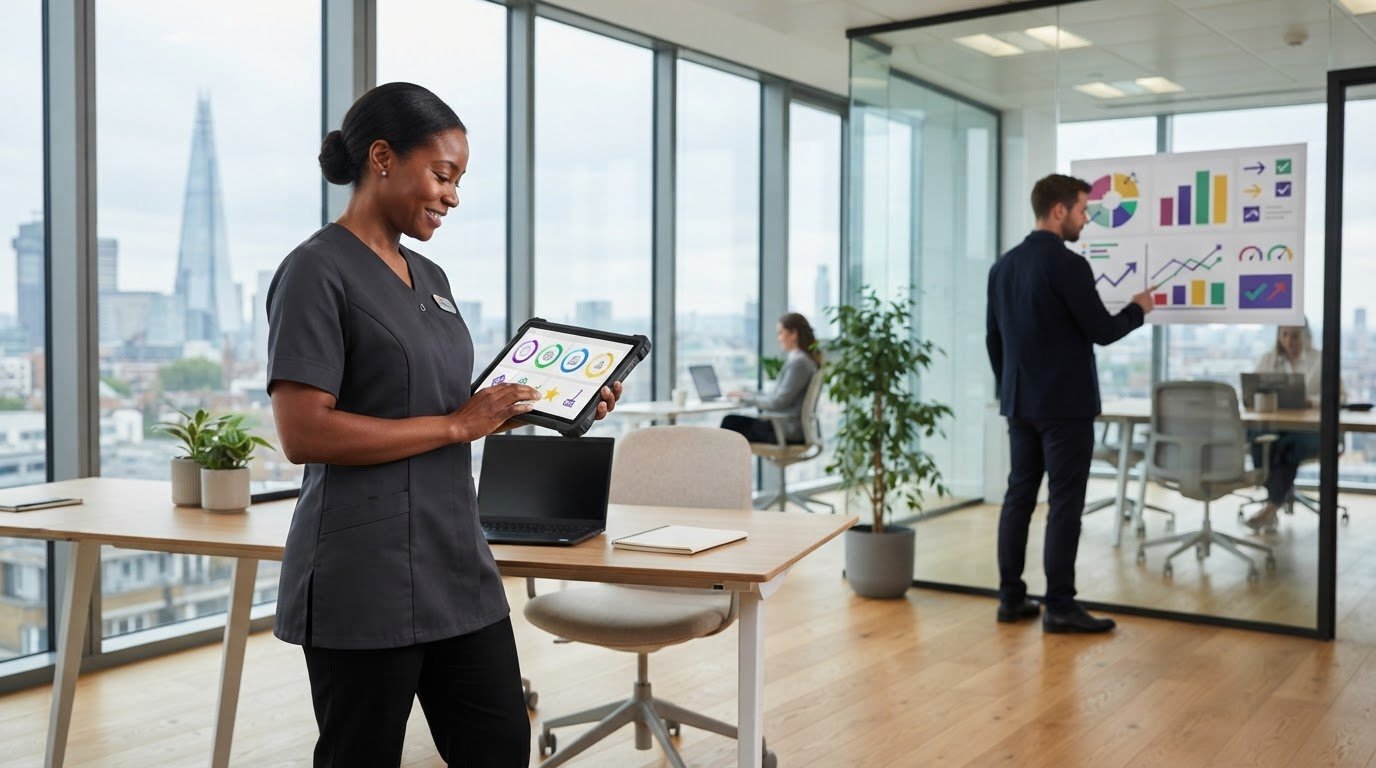
UF Cleaning’s directly employed, vetted and background-checked in-house teams use low-VOC, non-toxic, 100% biodegradable cleaning chemicals and HEPA-filtration vacuums. Scheduling can be arranged for early-morning, evening, daytime, weekend and 24/7 rapid-response needs. Quality control uses the Taskbe platform, which provides real-time activity updates, staff and rota visibility, and fast issue reporting, alongside quality checks and client feedback.
UF Cleaning is CHAS Approved, ISO 9001 Certified, a BICSc Member, and an Investors in People organisation. For hotel cleaning, the “Free Quote & First Service FREE*” offer provides a way to assess the service. A free, no-obligation quotation is based on the building, work required, cleaning hours, frequency and service arrangements.
Make consistent care part of the guest experience
A considered cleaning routine is more than a maintenance task; it helps shape how guests experience a hotel from arrival onwards. Review how shared spaces are used, identify where standards are hardest to maintain, and align daily priorities with the way guests and staff move through the building.
UF Cleaning offers Hotel Cleaning & Housekeeping and Hotel Management Support, alongside Office & Commercial Cleaning and Carpet, Window & Floor Care. A planned service can bring cleaning responsibilities into a clearer routine, with attention directed towards the spaces that matter most to hotel operations. Thoughtful hotel public area cleaning supports a welcoming environment and gives teams a practical framework for maintaining it.
Request a free, no-obligation quote from UF Cleaning to discuss a cleaning plan for your hotel. Contact UF Cleaning for support.
Frequently Asked Questions
What does hotel public area cleaning include?
It includes maintaining guest-facing facilities beyond bedrooms, with tasks adapted to how each space is used. For example, a business centre needs its keyboards, mice and phones cleaned and sanitised, while gym equipment such as weights and mats needs cleaning between uses. Banquet halls also need attention around functions, so the space is prepared for its next booking and remains presentable for guests.
How often should hotel public areas be cleaned?
Set the frequency according to each area’s use, then add cleaning around specific activities. A breakfast room, for instance, needs attention as service ends and the room changes over; a banquet hall requires preparation before and cleaning after each function. Routine schedules can also include daily, weekly, monthly and periodic tasks, with daytime checks helping staff respond to fresh spills or marks.
What risks and hazards should hotel public area cleaners manage?
Key hazards include wet floors, obstructed routes, cleaning equipment in guest pathways and unsuitable handling of cleaning substances. Staff should use signs around active floor cleaning, keep equipment clear of exits and choose products for the surface being treated. Regulation 3 of the Management of Health and Safety at Work Regulations 1999 requires workplace health and safety risk assessments, according to UK Parliament.