What should you look for in an education cleaning company UK schools can depend on? A detailed task list may look reassuring, but it won’t show whether standards can be maintained through a busy term, staff understand your site’s safeguarding arrangements or schedules can adapt to changing site use.
Choosing a provider takes more than comparing promises. You need to understand how work is specified, checked and adjusted when circumstances change, and how cleaning will fit around pupils, staff and the school calendar.
This guide offers a practical framework for assessing an education cleaning partner. It covers cleaning standards, staff conduct, site access, measurable quality checks and how to align routine and periodic work with term dates and site use. Use these criteria to compare providers and set clear expectations for the service.
Key Takeaways
- Check whether a provider can adapt its cleaning approach to your setting’s hygiene priorities, site requirements and school calendar.
- Ask how staff access, supervision, training and incident reporting will align with your written safeguarding and site procedures.
- Compare in-house, outsourced and blended models by accountability, cover, reporting and the capacity needed to manage the service.
- Give every bidder the same site information and scope, then agree measurable checks and review points before selecting a provider.
- UF Cleaning provides education cleaning across the UK, with flexible schedules and real-time quality monitoring through Taskbe. Confirm how the monitoring works when reviewing its proposal.
What should an education cleaning company UK schools expect to deliver?
An education cleaning company should adapt its work to how each site is used. The aim is dependable hygiene, spaces ready for their intended use and a clearly managed service, not a generic task list applied uniformly to every building. Consistent attention to shared spaces and frequently touched surfaces is part of everyday hygiene practice. The foundations of hygiene standards help explain why those areas matter.
First, distinguish routine cleaning from specialist or periodic work. A proposal may cover regular care of specified areas, while carpet, window or hard-floor cleaning could be included, scheduled separately or excluded. Ask the provider to confirm exactly what is covered, how often each task is planned and how additional requirements will be agreed.
Which education settings need a tailored cleaning plan?
Operating patterns vary between settings. A nursery may have different room use and daily routines from a school, while colleges and universities may have varied timetables, larger shared spaces or facilities used at different times. These differences make a site-specific assessment important, but they do not dictate one standard cleaning model.
Map the spaces that need attention, including classrooms, corridors, reception areas, washrooms and dining areas. Then consider how community use, events, holiday opening or timetable changes affect access and cleaning frequency. For example, a room used for evening activities may need a different schedule from one that is vacant at that time.
What should a cleaning specification make clear?
List the areas in scope, tasks, frequencies, service hours and agreed exclusions. Identify which work is routine and which needs separate planning, such as carpet, window or hard-floor cleaning. A shared brief gives providers the same basis for preparing proposals and helps you compare like with like.
A clear education cleaning specification defines the spaces, tasks, frequencies, service hours and exclusions, so both parties understand what’s expected.
Before agreeing a proposal, check that the schedule reflects term dates and actual site use, rather than assuming a standard weekly pattern will fit. Ask how changes to opening arrangements and one-off events will be handled, and who should be contacted to discuss adjustments. Record these expectations so you can identify gaps and review whether the service continues to suit the setting.
How to assess education cleaning standards, safeguarding and site controls
A proposal should explain how the provider will meet your setting’s written requirements, not just promise a high standard. Ask how cleaning methods are selected for different spaces, who supervises the work, what training staff receive and how concerns are escalated. A classroom, dining area and washroom may need different task instructions and checks. Assess the answers against your site’s priorities and procedures.
Scrutinise safety arrangements too. Ask how the provider identifies and communicates risks associated with cleaning products and equipment, and how its procedures fit your site’s requirements. The Health and Safety Executive (HSE) and the Control of Substances Hazardous to Health (COSHH) Regulations may be relevant references. Confirm which requirements apply to your organisation and nation before making assumptions about compliance. GOV.UK provides official government guidance for schools to consider alongside their own policies.
What safeguarding and access questions should buyers ask?
Establish who leads the site induction, grants access permissions and explains visitor procedures. Clarify how cleaning staff are expected to behave on site, which areas are restricted and what to do if they encounter an unexpected situation. Ask how incidents or safeguarding concerns are reported, who receives the report and how urgent matters are escalated.
Do not assume the same vetting arrangements apply to every role or setting. Confirm any required checks with your safeguarding lead, taking account of your organisation’s policy and the rules that apply in your UK nation. Ask the provider how its proposed arrangements will work with your site procedures, and record responsibilities before the service begins.
How can you make cleaning quality measurable?
Agree standards that can be observed, such as whether specified areas and touchpoints have been completed to the required condition. Set out how often inspections take place, who carries them out, who owns follow-up and how corrective actions are recorded. If an area is repeatedly missed, a clear process lets you assign the issue and review whether it has been resolved.
Measurable standards require documented checks, named responsibility and timely follow-up on identified issues.
Ask how concerns are logged, assigned, resolved and reviewed, and what information will be available during service discussions. UF Cleaning states that its education cleaning service includes real-time quality monitoring through Taskbe. Confirm the current scope and operation of that monitoring when assessing a proposal. If you’re defining requirements for an education cleaning company UK provider, reviewing UF Cleaning’s education cleaning service may help you consider what monitored support could look like.
How to compare education cleaning companies and service models
Compare service models against the capacity your organisation already has. An in-house team may offer direct day-to-day oversight, while outsourcing can shift responsibility for managing the cleaning operation to a provider. A blended model combines internal coordination with external cleaning support. None is automatically cheaper or more effective. The right fit depends on your site, calendar and available management time.
Which service model fits your education setting?
Consider who will organise tasks, supervise delivery and respond when arrangements need to change. Ask each provider how planned absences, urgent schedule changes and out-of-hours requirements would be handled, and what cover or management support is included in the proposal. Check that the proposed team and oversight suit the number and use of your spaces. A model that works elsewhere may not fit your site.
Keep routine daily or weekly cleaning distinct from separately agreed specialist work. Confirm which tasks are included, how additional work is arranged and who coordinates it. The British Institute of Cleaning Science can be a useful reference when considering cleaning practice and training. Ask providers to explain how their approach and any relevant staff training meet your requirements.
Compare proposals on consistent criteria
Give each bidder the same requirements, then use a simple comparison to spot differences that broad service descriptions may hide.
| Area | What to compare |
|---|---|
| Scope | Spaces and routine tasks covered, plus exclusions and separately arranged specialist work. |
| Schedule flexibility | How the plan responds to term patterns, holidays, events and agreed changes. |
| Supervision | Who oversees delivery and how responsibilities are divided between provider and site. |
| Reporting | How checks and concerns are recorded, shared and followed up. |
| Specialist tasks | How these are defined, scheduled and approved outside routine cleaning. |
Which quality and sustainability details belong in a comparison?
Look beyond general promises of quality. Compare inspection processes, access to reporting and responsibility for corrective actions. Ask what “eco-friendly products” means in practice, request relevant product information and check how the proposed products suit your setting’s requirements. UF Cleaning describes its education cleaning service as using eco-friendly products and offering real-time quality monitoring through Taskbe. Confirm the current product details and monitoring scope as part of your assessment.
You can review UF Cleaning’s education cleaning support alongside other proposals. A fair comparison of an education cleaning company UK buyers can assess starts with responsibilities, flexibility and reporting, not a general claim that one service model suits every setting.
What to include in an education cleaning tender or provider review
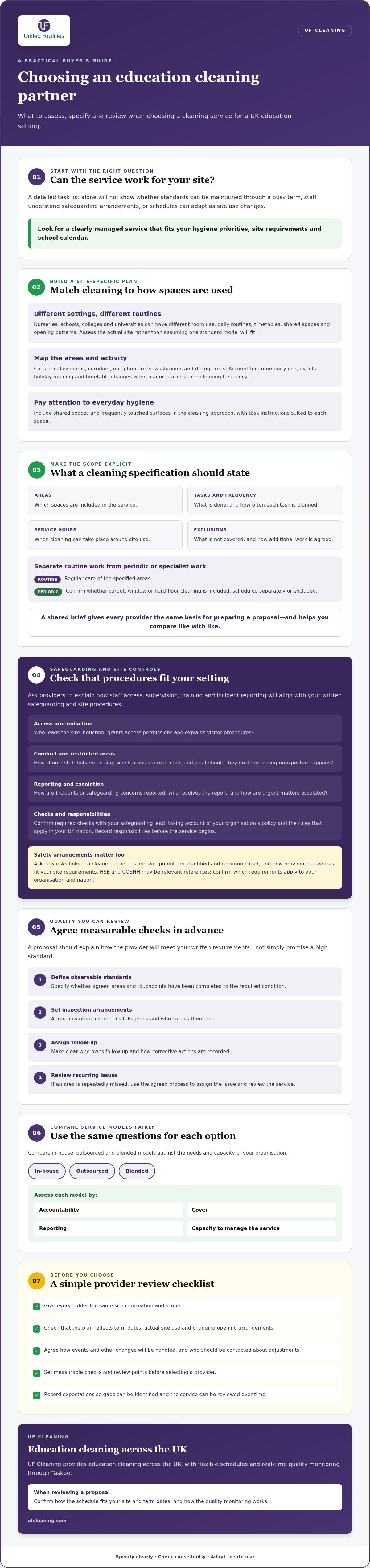
A structured review helps you compare providers on the same basis and identify unclear responsibilities before agreeing a service. Work through the process in order: map how the site is used, define the cleaning scope, assess proposed controls, compare responses and agree how performance will be reviewed. Give each bidder the same site information, priorities and requirements so differences between proposals are easier to assess.
- Map needs: describe the spaces, patterns of use, term dates and any holiday or event arrangements that affect cleaning.
- Define scope: specify tasks, frequencies, service hours, exclusions and any separately arranged work.
- Assess controls: review proposed supervision, communication, access arrangements and quality reporting.
- Compare and agree: check how changes will be handled and set review points with named responsibilities.
Which questions should you ask prospective providers?
Ask how schedules can accommodate term dates, holidays and changes in site use, and who will oversee delivery. Clarify how concerns reach the responsible contact, how planned absences or other changes are managed, and what escalation route applies if an issue needs attention. Request examples of reporting and quality-review processes, then decide whether they give your organisation the visibility it needs.
Discuss mobilisation too: what information the provider needs before the service starts, how site procedures will be communicated and how initial questions will be handled. These details help you judge whether the proposed arrangements are workable, rather than simply complete on paper.
How should you review a proposal and service agreement?
Check that the written proposal matches your specification. Tasks, frequencies, exclusions and responsibilities should be clear and consistent. Confirm how additional tasks, schedule changes and performance reviews will be agreed. Read the mobilisation, communication, cover and escalation arrangements alongside the cleaning schedule so operational expectations are explicit.
Before signing, review the agreement’s wording and ask appropriate advisers to check contractual terms, insurance evidence and any checks your organisation requires. Resolve gaps or ambiguous wording with the provider, and record agreed review points so both parties understand how concerns will be raised and discussed. This gives you a sound basis for selecting an education cleaning company UK organisations can assess against their specific requirements.
Once your scope and priorities are documented, review UF Cleaning’s education cleaning service as you compare proposals.
Why consider UF Cleaning as your UK education cleaning company?
UF Cleaning provides education cleaning as part of its commercial cleaning services across the UK and has served organisations since 2010. For education buyers, the stated features to explore include flexible schedules, eco-friendly products, 24/7 operational support and real-time quality monitoring through Taskbe. Use these as starting points for discussion, then assess them against your site requirements and the scope set out in a proposal.
How does UF Cleaning’s stated approach support education buyers?
Flexible scheduling may help shape a cleaning plan around a setting’s operating calendar, including term dates, holidays and changes in site use. Discuss the hours and areas your site needs covered, then confirm how the proposed schedule would accommodate them. A stated service feature is not a substitute for agreeing specific arrangements in writing.
UF Cleaning describes Taskbe as providing real-time quality monitoring. Ask what information the platform currently records, who can access it and how concerns and follow-up actions are handled. Monitoring can support service visibility and review discussions, but confirm the details before treating the platform as evidence of a particular inspection process or outcome.
The company also describes its products as eco-friendly and provides 24/7 operational support. Ask what product information is available and how support works for your proposed service. These features do not, on their own, establish compliance with your organisation’s safeguarding, health and safety or cleaning requirements. A provider should be able to discuss its stated service features against your site’s defined needs, rather than relying on broad assurances.
What information should you prepare before requesting a quote?
A concise site brief can make the discussion more useful. Prepare details such as:
- Setting and spaces: the type of education site, areas in scope and any spaces with distinct cleaning needs.
- Operating pattern: opening hours, term dates, holiday use, events and your preferred cleaning schedule.
- Site arrangements: relevant access procedures and any practical restrictions the provider should understand.
- Service priorities: your expected standards, reporting needs and any specialist tasks to discuss separately.
With these requirements to hand, you can ask focused questions and assess whether the proposed service fits your setting. The site details, preferred schedule and priorities will also help structure a discussion with a provider.
Make your next cleaning decision with confidence
Choose an education cleaning company by defining what your site needs, checking how safeguarding and quality controls will work in practice, and comparing proposals against the same scope. A well-documented arrangement makes responsibilities clear and gives you a useful basis for reviewing the service over time.
UF Cleaning provides education cleaning and states that it has served organisations since 2010. Its stated features include 24/7 operational support and real-time quality monitoring through Taskbe. Discuss how these features apply to your requirements and confirm the current scope of the monitoring before making a decision.
Frequently Asked Questions
How do I choose an education cleaning company in the UK?
Start with a written specification of the areas, tasks, frequencies, service hours and exclusions. Give each provider the same brief, then compare supervision, staff induction, access procedures, quality checks, reporting and schedule flexibility. Ask who receives concerns and how they’re resolved. Before appointment, confirm safeguarding and safety requirements with the appropriate leads and advisers for your setting and UK nation.
What should an education cleaning contract include?
A clear agreement should state which locations and routine tasks are covered, how often work takes place, the service hours, exclusions and each party’s responsibilities. It should also explain supervision, communication, quality reviews, issue escalation and how changes are approved. Identify specialist work that needs separate scoping. Before signing, check that the final terms match the agreed specification and follow your organisation’s usual procurement and legal review processes.
Do education cleaners need safeguarding checks?
Required checks depend on the role, work, access arrangements, setting and applicable rules in the relevant UK nation. Do not assume every cleaner or site has identical requirements. Ask the provider how staff are inducted, supervised and authorised to access areas, then discuss necessary checks with your safeguarding lead and appropriate advisers. Record agreed responsibilities and procedures before the service begins, in line with your organisation’s safeguarding arrangements.
How often should a school or college be cleaned?
There’s no single frequency that suits every school or college. Base the schedule on occupancy, building layout, activities, opening hours and how different areas are used. For example, a busy dining area may need a different task frequency from a room used occasionally. Agree the plan against your hygiene requirements, then review it when term dates, events, enrolment or building use change. Document agreed adjustments with the provider.
Can an education cleaning company work around term dates and holidays?
Ask providers to plan proposed schedules around term dates, holiday opening and events, then confirm the specific arrangements before appointment. Ask how to request a change, who approves it and whether extra tasks need separate agreement. Share the academic calendar and known periods of increased or reduced use when seeking proposals. This helps the provider respond to your operating pattern rather than assume every site follows the same schedule.
How can we monitor an education cleaning company’s performance?
Agree observable standards, inspection arrangements, reporting responsibilities and a process for addressing concerns. Establish who reviews findings, assigns follow-up actions and checks whether recurring issues have been resolved. If the provider uses digital monitoring, ask what the system records, who can access the information and how it supports service reviews. UF Cleaning states that its Taskbe platform provides real-time quality monitoring. Confirm the platform’s current scope and operation directly before relying on specific capabilities.
Are eco-friendly cleaning products suitable for education settings?
Suitability depends on the product, surface, task, instructions for use and your setting’s operational requirements. Ask the provider which products it proposes and request relevant product information, including instructions for safe use and storage where applicable. An environmental description alone doesn’t establish that a product suits every area or purpose. Check proposed choices against your organisation’s requirements and relevant safety guidance, and clarify how product use will be communicated to those responsible for the site.
Request a free education cleaning quote from UF Cleaning, and share your site details, preferred schedule and service priorities to discuss your requirements.