A clean-looking office is only one part of a well-performing cleaning contract. The key performance indicators for office cleaning contractors are measurable checks of service quality, agreed task completion, staffing, attendance, documentation and productivity. A practical scorecard uses three to seven clear measures chosen to reflect the contract and the building’s needs.
It’s reasonable to expect cleaning to be consistent, but a useful KPI framework shows what supports that consistency and where improvement is needed. This guide explains what each measure can reveal, how audits and staff records support a fair assessment, and why floor area per labour hour adds important context to productivity. It also shows how to interpret results without treating speed as a substitute for quality.
Key Takeaways
- Set clear complaint acknowledgement and resolution times, then use logged issues to spot recurring service problems and guide follow-up.
- Use consistent quality audits, with BICSc guidance or ISO-based quality management helping to structure checks and interpret results.
- Track training, attendance, absence cover and site documentation together to understand whether staffing practices support consistent delivery.
- Compare cleaned floor area with labour hours, using the recommended target of at least 1,500 square feet per labour hour for typical office environments as a productivity reference.
1. What Affects Cleaning KPI Performance?
Cleaning KPIs measure delivery against the activities and frequencies set out in the office cleaning contract. A useful scorecard connects task completion, service quality, responsiveness and customer satisfaction, rather than relying on one overall impression. For example, record whether a scheduled washroom clean was completed, whether the area met the agreed standard, and whether reported problems were handled promptly. Sample targets include at least 98% completion of daily tasks and 100% adherence to contracted cleaning frequencies.
Complaint tracking makes responsiveness visible. Record when each issue is received, acknowledged, assigned and resolved, then compare those timestamps with agreed service parameters. Sample measures are acknowledgement within 4 working hours and resolution of routine complaints within 2 working days. Separate urgent issues, such as a spillage, from routine requests, since the required response depends on the problem and its effect on the workplace. Review repeat complaints to identify whether corrective work addressed the underlying cause.
On-time completion shows whether planned cleaning happens when expected, while schedule adherence checks whether each contracted frequency is met. A sample target is at least 95% on-time completion; UK cleaning contracts commonly target SLA compliance of 90–98%. These measures are related but distinct: a task may be completed, yet late, or on time but below the specified standard. Track periodic work, such as window cleaning, alongside daily tasks so less frequent activities remain visible.
Quality and compliance audits test the result against the scope of works. Record scores by zone, such as offices, kitchens and washrooms, and log actions needed after a failed check. Customer satisfaction can be measured through survey results and helpdesk issues; a sample target is an average score of at least 4.0 on a 1-to-5 scale. Feedback helps show whether audit findings match the experience of building users.
Review operational performance weekly to identify underperformance early, then report office cleaning contract KPIs monthly. Monthly reports should bring together completion, audit, complaint and satisfaction results, with clear actions and owners. This cadence connects day-to-day tracking with formal compliance reviews and gives both parties a consistent performance record.
2. How do you measure cleaning quality?
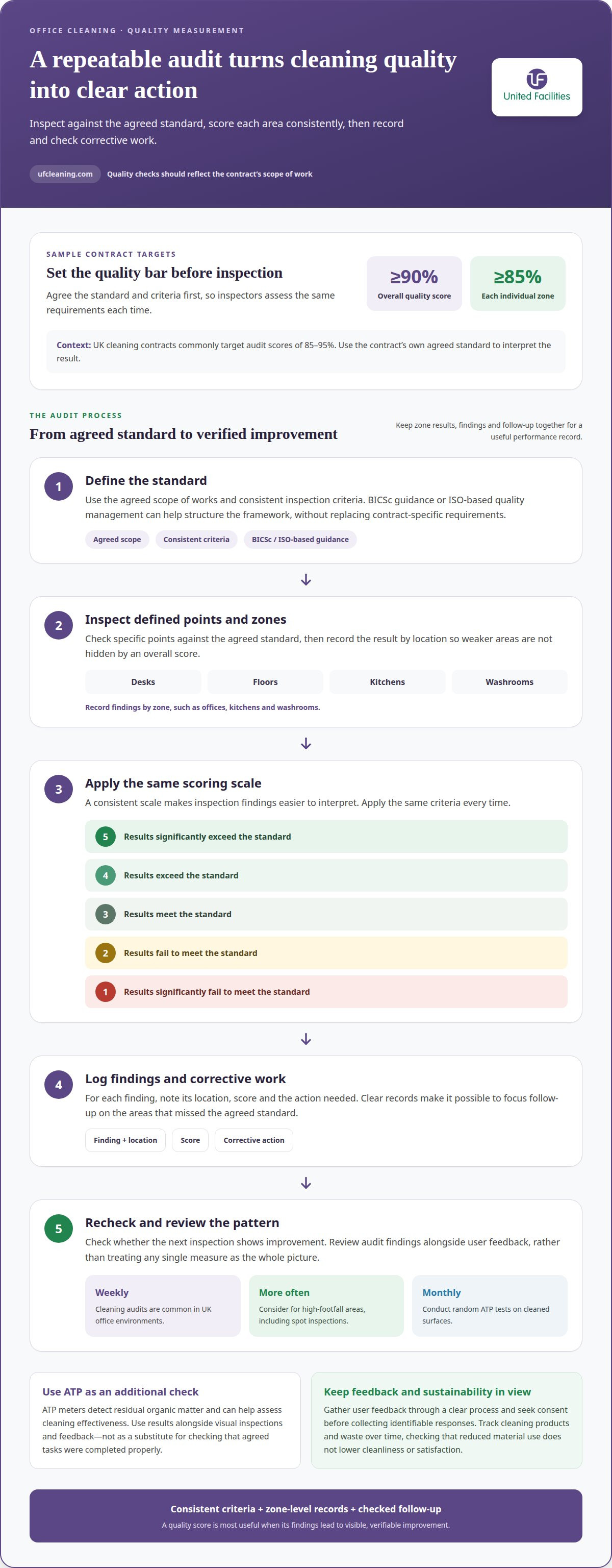
Use a repeatable inspection audit to compare cleaned areas with the agreed standard. Inspect defined points, such as desks, floors, kitchens and washrooms, then record results against consistent criteria. A sample contract target is an overall quality score of at least 90%, with every individual zone scoring at least 85%. Recording zone scores separately helps reveal whether one area needs focused attention, even when the overall result meets its target.
A scoring scale makes inspection findings easier to interpret. One framework assigns 5 when results significantly exceed the standard, 4 when they exceed it, and 3 when they meet it. Scores of 2 and 1 indicate failure to meet, or significant failure to meet, the defined standard. UK cleaning contracts commonly target audit scores of 85–95%, but the measure is useful only when inspectors apply the same criteria each time.
BICSc guidance and ISO-based quality management can help structure inspection criteria and review processes. They provide reference points for a consistent framework, rather than replacing the contract’s specific scope of work. Weekly cleaning audits are common in UK office environments; high-footfall areas may need more frequent audits or spot inspections. Record each finding, location, score and corrective action, then check whether the next inspection shows improvement.
For an additional surface check, ATP meters detect residual organic matter and can help assess cleaning effectiveness. Random ATP tests of cleaned surfaces should be conducted monthly. Treat the results as one part of quality monitoring, alongside visual inspections and feedback, rather than as a substitute for checking whether agreed tasks were completed properly.
To measure sustainability, collect records of cleaning products used and waste produced, then compare them over time alongside audit results. Track whether changes reduce material use without lowering cleanliness or satisfaction. Gather user feedback through a clear process, seeking consent before collecting identifiable responses. For consistent office cleaning inspections and follow-up, explore office cleaning services.
3. Staff training, attendance and documentation
Staffing metrics show whether the people assigned to a workplace can deliver its cleaning plan consistently. A training matrix records each operative’s completed instruction and site-specific requirements, while attendance records show who worked each scheduled shift. Include right-to-work documents in contract records, alongside current work plans and details of absence cover. Together, these records help identify gaps before they affect service delivery.
Attendance and punctuality are separate measures. Record whether each operative attends and arrives in time to begin the planned shift, then compare results with scheduled hours. A sample attendance target is at least 95% of scheduled shifts. Tracking late arrivals alongside missed shifts helps distinguish punctuality issues from absence, making follow-up more precise.
Absence cover deserves its own measure because a recorded absence does not show whether the cleaning tasks were covered. A sample target is same-day cover for at least 90% of staff absences. Log the absence, cover arrangement and tasks affected, then note any changes to the work plan. This makes the impact on service visible and supports accurate performance reviews.
Turnover can affect continuity: a stable team is more likely to retain familiarity with site routines and standards. Track retention alongside training participation and attendance, rather than treating any single figure as a complete assessment. If the same task needs repeated correction after staff changes, review site induction and coaching records. Training should address the specific procedures or areas where performance needs to improve.
Documentation makes these metrics usable. Operatives should complete the signing-in book, and office doors should be locked. Managers can check these records against attendance, current work plans and absence cover. Clear, up-to-date documentation helps explain missed tasks, confirms who was present and shows whether site procedures were followed. For commercial cleaning, linking records to the relevant shift and work area gives contract reviews a practical evidence trail.
4. Office cleaning productivity by floor area and labour hour
Measure productivity by dividing the area cleaned by the labour hours used. For typical office environments, the recommended target is at least 1,500 square feet per labour hour. Treat this as a reference point, not a standalone judgement: the work’s scope, cleaning frequency and building layout affect what the figure means.
Consider an office of around 800 square metres across two floors. Record the hours spent on each floor and the areas included, then compare delivery with the agreed task list. A floor with more washrooms, kitchenettes or detailed touchpoints may take longer than open-plan space. These differences explain why a single area-per-hour figure needs context.
Read productivity alongside inspection results and service feedback. If output rises while audit scores fall, investigate whether tasks were missed or standards were compromised. If hours increase, review what changed: additional cleaning needs, difficult access or a revised scope may explain the difference. The useful KPI is not simply speed, but work completed to the required standard within planned labour time.
Clients comparing KPI results should use the same scope, floor area, labour-hour method and reporting period for each comparison. Then consider quality scores, completed tasks and staffing records beside productivity, so a faster figure does not conceal reduced service. UK cleaning contracts commonly target SLA compliance of 90–98%; sample targets include at least 95% on-time completion and at least 98% completion of daily tasks.
Set targets against the site’s actual needs and record the calculation consistently. A monthly review can show whether productivity changes follow changes in area, frequency or work requirements, while weekly monitoring can prompt earlier action. Keep feedback and audit findings alongside the area-per-hour measure to give contract discussions a clearer view of both efficiency and delivery.
For a tailored productivity plan that reflects your office’s floor area and cleaning requirements, discuss office cleaning requirements.
UF Cleaning
UF Cleaning helps organisations turn office cleaning requirements into a considered service plan, supported by flexible schedules and real-time quality controls. This is a practical next step when KPI results point to inconsistent delivery, changing workplace needs or a need for clearer oversight. Agreed tasks and cleaning frequencies provide a foundation for reviewing quality, attendance and productivity in context, rather than treating one score as the whole picture.
UF Cleaning provides office cleaning shaped around each workplace’s requirements. Directly employed, vetted teams support a clean, well-managed environment through consistent service delivery, quality checks and client feedback. Contact UF Cleaning to discuss your office cleaning requirements and the measures that matter to your organisation.
Make your next review more useful
The next step is to turn performance discussions into practical decisions. Use your measures to identify which priorities need attention, who will take action, and how the result will be assessed at the next review. This makes reporting a working tool for improving the service, rather than a record detached from daily operations.
A well-designed set of key performance indicators for office cleaning contractors should reflect your workplace’s requirements and support clear conversations about service delivery. As those requirements change, revisit the measures so they remain relevant to the spaces, tasks and experience that matter to your organisation.
UF Cleaning can discuss your office cleaning requirements and how a considered service plan can support your priorities. Contact UF Cleaning to start the conversation and identify a practical way forward for your workplace.
Frequently Asked Questions
What Are Cleaning KPIs?
Cleaning KPIs are measures used to assess whether a cleaning service is meeting its objectives. They turn expectations into evidence that can inform contract decisions. For example, a facilities manager might use them to identify a recurring shortfall in a particular building area. Each measure is most useful when its calculation, reporting owner and intended response are clear.
How do you measure cleaning quality?
Measure cleaning quality by inspecting agreed areas against documented criteria, then recording observations consistently. For example, assess whether a meeting room is ready for use, not simply whether a cleaner attended. Link inspection records to locations and dates so patterns can be distinguished from isolated issues. Combining these findings with user comments can show whether measured standards reflect the workplace experience.
How often should cleaning audits be done?
Set an audit schedule that reflects building use, footfall and recent service changes. A routine inspection can provide a baseline, with additional checks after a complaint, a change in cleaning scope or a corrective action. Reviewing results at contract meetings helps determine whether the schedule remains suitable. Busy shared areas may need closer observation than spaces used infrequently.
What Affects Cleaning KPI Performance?
Performance can shift when the work scope, building occupancy or access arrangements change. A newly used meeting area, for instance, may add cleaning demand without appearing in the original task plan. Equipment condition, supply availability and staff familiarity with site procedures can also influence delivery. Recording relevant operational changes alongside KPI results helps distinguish a service issue from a changed requirement.
What is a good cleaning KPI score?
A good score meets the threshold agreed for that measure and reflects reliable performance across the areas assessed. The score alone can mislead if inspection criteria vary or weaker areas disappear within an overall average. Consider whether results are consistent, recurring issues are being addressed, and users report a suitable standard. The contract should define how scores are calculated and interpreted.
What are the key performance indicators (KPIs) for office cleaning contractors?
The key performance indicators for office cleaning contractors show whether agreed objectives are being achieved. Common categories include service quality, completed work, responsiveness, staffing, user satisfaction and resource use. Choose measures that relate directly to the contract, rather than collecting figures without a purpose. A concise dashboard can show who reviews each result and what action follows a shortfall.