What if the cleaning record shows a floor was attended to, but not whether a spill was found, made safe or checked afterwards? That gap matters when a workplace is trying to understand a slip or trip. Clear slip and trip liability workplace cleaning standards connect routine cleaning with hazard controls, defined responsibilities and evidence of follow-through.
It’s understandable to be unsure who is responsible when an incident happens. Duties may be shared across the people who manage a workplace, those who use it and the cleaning team, depending on the circumstances and agreed arrangements. A warning sign or completed checklist can help, but it needs to be part of a practical process for identifying hazards, responding promptly and recording what happened.
This article explains how cleaning can help manage foreseeable slip and trip risks, and what workplace procedures can include, from planned floor care and spill response to inspections, signage and useful records. It also considers how scheduled cleaning and recorded quality monitoring, such as UF Cleaning’s Taskbe platform, can support consistency as part of a wider risk-control system.
Key Takeaways
- Understand how slip and trip liability workplace cleaning standards can help manage foreseeable floor hazards through clear, risk-based controls.
- Distinguish between wet or contaminated surfaces and obstructions, then match the response to the hazard.
- Clarify who is expected to inspect, clean, report and escalate issues through site procedures and agreed responsibilities.
- Build practical daily routines that adapt to changing conditions and record key actions for review.
- See how coordinated cleaning delivery and recorded quality monitoring can support consistent standards alongside workplace oversight.
Slip and trip liability in the workplace: how cleaning standards fit
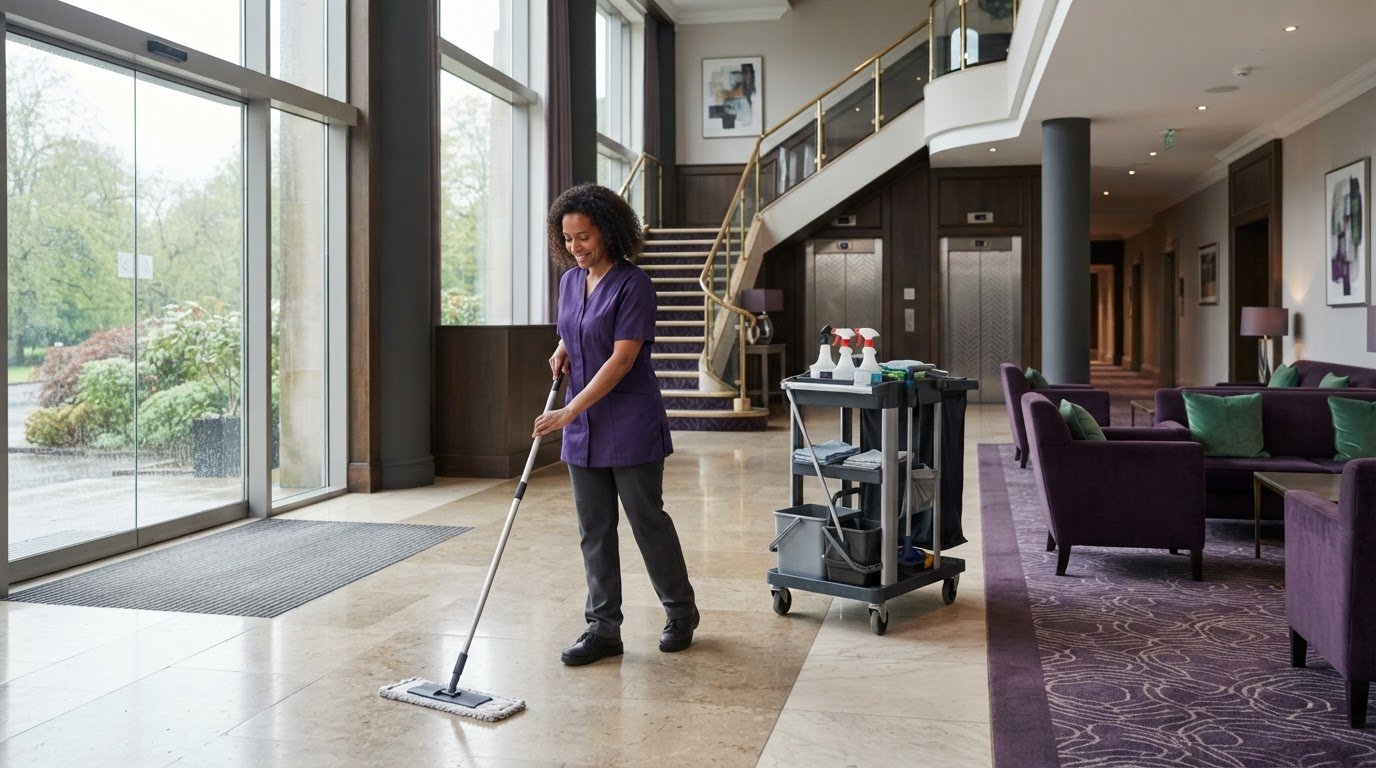
Cleaning can remove hazards, but the work itself can temporarily change the condition of a floor. A freshly mopped entrance, an unmarked spill or detergent residue may reduce grip and create a slip risk. A trailing vacuum lead, a displaced floor mat or equipment left in a walkway may cause a trip. Grit and other contamination can affect traction or conceal uneven surfaces.
Risk depends on context. A damp patch beside a quiet room may present a different level of exposure from a wet entrance used continuously by staff and visitors. Flooring, footfall, water tracked in during wet weather and the timing of cleaning all affect how likely someone is to encounter a hazard. The practical question is not simply whether cleaning took place, but whether foreseeable conditions were identified and managed.
What counts as a cleaning-related slip or trip hazard?
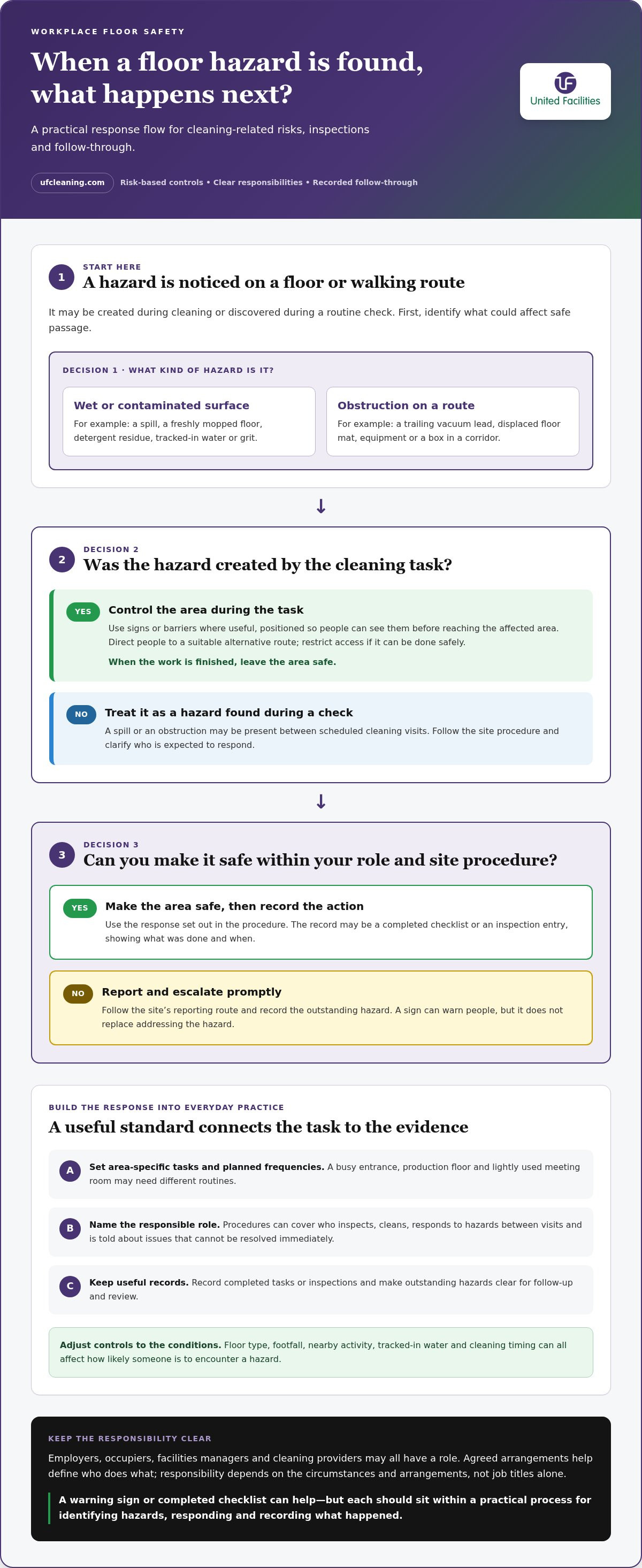
A hazard may arise from a cleaning task, such as a wet floor or a lead crossing a route, or be found during an inspection, such as a drink spill or a box obstructing a corridor. These situations call for distinct responses. Cleaning staff should leave the area safe after their work; hazards discovered during a check need to be made safe or promptly reported and escalated under site procedures. Clear signage can warn people, but it does not replace addressing the hazard.
How do workplace duties relate to cleaning?
Workplace safety legislation, including the Health and Safety at Work etc. Act 1974, the Management of Health and Safety at Work Regulations 1999 and the Workplace (Health, Safety and Welfare) Regulations 1992, provides a framework for managing risks. These regulations address workplace risk management, floor condition and keeping floors and traffic routes free from obstructions. Requirements can vary across UK jurisdictions.
These duties guide prevention; they do not determine legal liability in any individual incident. A claim may depend on the circumstances, applicable duties, who controlled or occupied the premises, what each party knew or should reasonably have known, and the available evidence. Slip and fall liability provides a general introduction to premises claims, but workplace questions must be considered against the relevant law and facts.
Responsibility can involve several parties. Employers manage workplace risks for staff; occupiers control premises and access; facilities managers may coordinate site procedures; and cleaning providers carry out agreed tasks and report issues within their role. Contracts and site arrangements help define who cleans, who responds to hazards found between visits, and who is told when an issue cannot be resolved immediately. The precise allocation depends on the arrangements, not job titles alone.
A risk-based cleaning standard is more useful than a promise of zero risk: it sets proportionate precautions, assigns ownership and makes follow-through easier to demonstrate. In practice, slip and trip liability workplace cleaning standards should reflect how each area is used, while distinguishing a hazard created by cleaning from one identified during routine checks.
Which workplace cleaning standards help control slip and trip risks?
A useful cleaning standard turns broad safety aims into instructions that can be followed consistently. It records what needs cleaning, how often planned tasks take place, which role is responsible and what to do when a hazard appears between scheduled visits. The level of control should reflect each area’s use: a busy entrance, a production floor and a lightly used meeting room may need different routines.
At a minimum, procedures should support clean, dry and unobstructed walking routes. They should account for floor materials, nearby work, expected footfall and conditions that can change during the day, such as water being tracked inside or a delivery temporarily narrowing a corridor. The aim is a practical, proportionate system, not one cleaning frequency imposed across every space.
What should a risk-based cleaning procedure include?
Set area-specific tasks and planned frequencies, then identify where additional checks may be appropriate, such as entrances or routes beside food and drink areas. Specify how staff should respond to spills, where to position equipment so it does not obstruct access, and how to report hazards they cannot resolve. Account for the floor surface and cleaning method so products, moisture and equipment use do not introduce avoidable risks.
A cleaning standard should specify the action, the responsible role and the evidence that the task was completed. That evidence might be a completed checklist or a recorded inspection, with a clear route for noting outstanding hazards. The OSHA guidance on cleaning-related slip and trip risks offers workplace control examples. OSHA is a US regulator, so its material is informative rather than a substitute for UK requirements.
When are signs and temporary barriers useful?
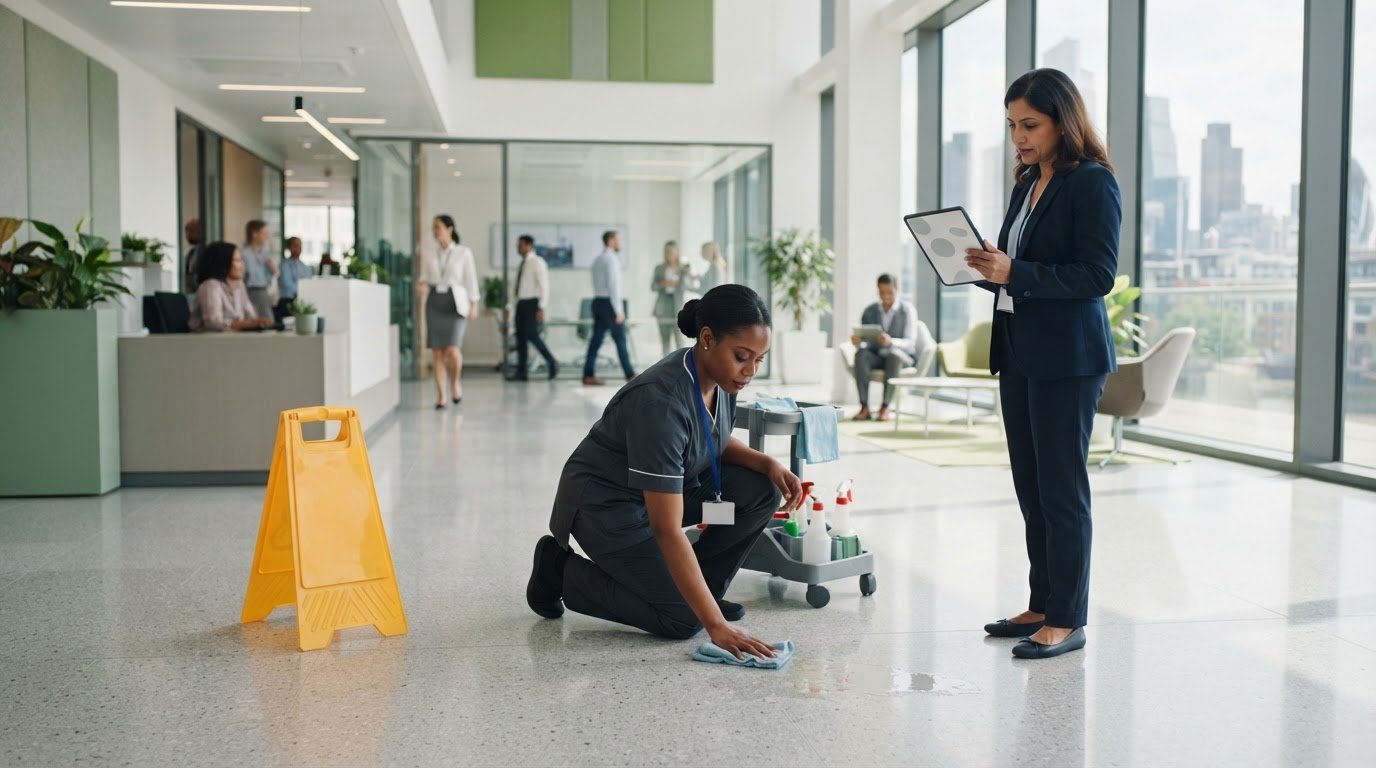
Signs and barriers communicate that a floor is being cleaned, remains wet or is temporarily unsafe to use. They are most useful when placed where people can see them before reaching the affected area, and when they direct people towards a suitable alternative route. Where access can be restricted safely, doing so can reduce exposure while a task is under way or the floor dries.
A sign alone does not remove a spill, make a poor cleaning method safe or prevent someone entering an area. Staff should act promptly, use an appropriate method and keep controls in place for as long as the hazard remains. Afterwards, they should check that the route is safe before reopening it, then remove signs and barriers so these do not become obstructions themselves.
For managers, the practical test is whether the written procedure matches real site conditions and can be followed during ordinary operations. Review it when room use, footfall or activities change, and make sure staff know how to raise an unresolved concern. Scheduled commercial cleaning can support consistent routines. UF Cleaning’s workplace cleaning services can form part of that coordinated approach.
Who is responsible, and what evidence matters after an incident?
Responsibility for safe floors can involve several people, particularly where cleaning is contracted or areas are shared. A role comparison helps identify who normally oversees a control and who carries it out, but it isn’t a legal finding. Contracts, site procedures and the facts of an incident all matter when responsibility is assessed.
| Role | Typical contribution |
|---|---|
| Employer or occupier | Oversees workplace or premises risks, sets site arrangements and ensures reported hazards have a route to action. |
| Facilities manager | Coordinates site procedures, communication and handovers between teams, and tracks issues that need follow-up. |
| Cleaning team or provider | Carries out agreed cleaning tasks, leaves the work area in an appropriate condition and reports hazards that need escalation. |
| Employees and site users | Follow local arrangements and report hazards they notice through the stated process. |
These are typical functions, not fixed legal allocations. A contract can define the cleaning provider’s tasks, but site procedures should also explain who responds to a hazard found between scheduled visits, who manages shared routes and who checks that an issue has been addressed. Handover arrangements are especially useful where one team finishes work before another takes responsibility, including during out-of-hours operations. No party is automatically liable simply because an incident occurred; the circumstances and applicable law must be considered.
Which cleaning and incident records are useful?
Records are most useful when they show what was observed, what action followed and whether the issue was resolved. A completed-task log can record the area and time of work; inspection notes can identify a defect or missed task; and a hazard report can show when an issue was raised, to whom and how it was escalated. Corrective-action records should capture the response and any follow-up check.
Incident evidence is strongest when records connect hazards, actions and follow-up. Use consistent details so separate entries can be understood together, including the time and location, relevant conditions, the person reporting the issue, and when controls were applied or removed. After an incident, create a factual report promptly, noting what is known and distinguishing it from assumptions. Relevant witness details or photographs may also help, where appropriate and handled under the organisation’s procedures.
Keep incident reports and supporting material in line with the organisation’s record-retention procedures. A completed checklist can show that a task was logged, but paperwork alone doesn’t establish that the control was adequate or followed in practice. For slip and trip liability workplace cleaning standards to be meaningful, recorded checks need to reflect actual site conditions and connect clearly to the response when something changes.
How to put workplace cleaning standards into daily practice
A reliable routine makes risk controls part of normal site operations, rather than a document consulted only after a problem. Managers and cleaning teams can use the sequence below to tailor checks to the building, coordinate handovers and identify where procedures need attention.
- Map areas and routes. Identify floors, entrances, shared walkways and work zones, then consider how each is used. Note foreseeable risks such as water ingress, high footfall, equipment movement or activities that can leave residue, and select controls suited to the surface and setting.
- Set tasks and ownership. Record the cleaning and inspection tasks for each area, who completes them, who checks them and who receives urgent reports. Include handovers between cleaning staff, facilities teams and site managers, so a discovered hazard isn’t left without a clear next step.
- Adapt checks to conditions. Use planned routines as a baseline, then respond to changing occupancy, wet weather or operational activity. For example, increased use of an entrance may call for closer observation of water tracked inside; a delivery or layout change may require attention to a newly narrowed route.
- Make the area safe and escalate unresolved issues. If a spill or other hazard cannot be dealt with immediately, follow site procedures to alert the responsible person and restrict access where appropriate. Record what has been done, what remains outstanding and who has accepted the handover.
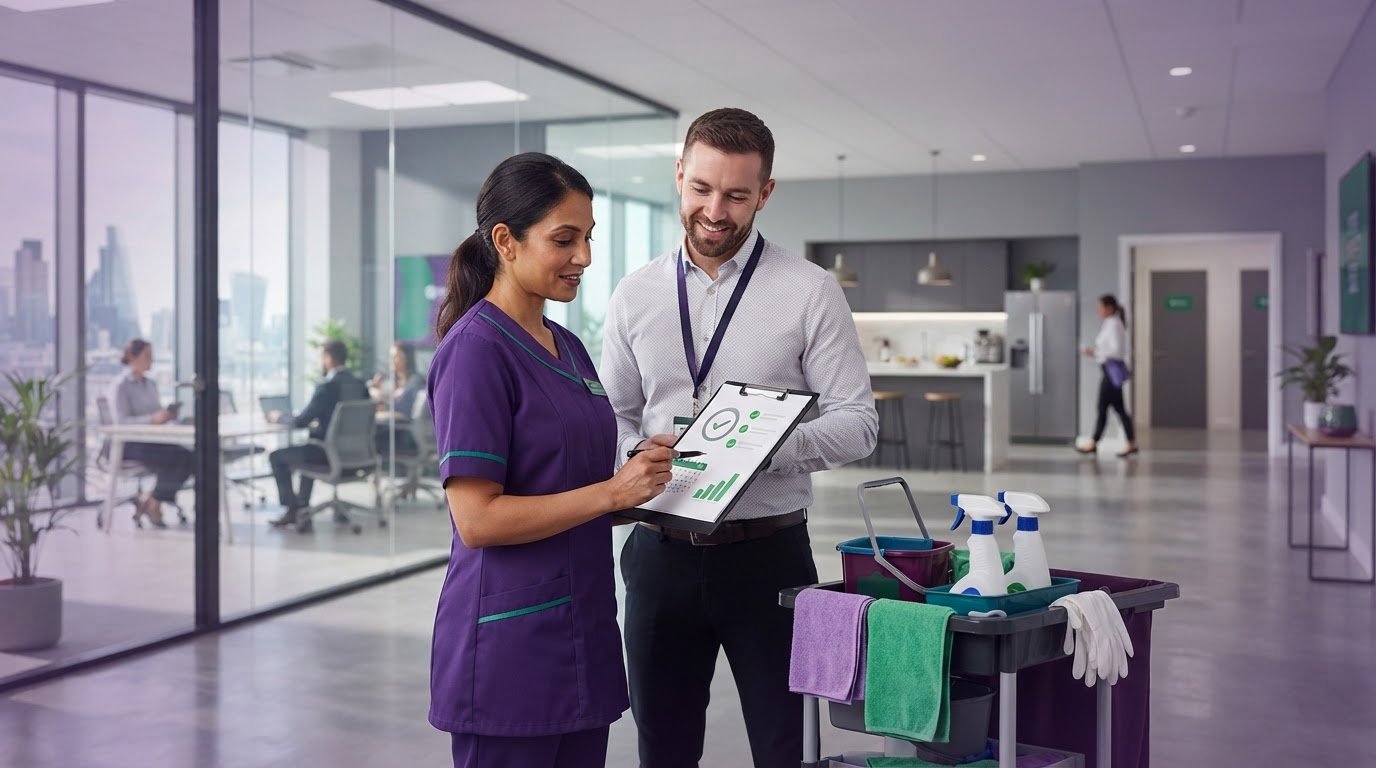
- Record completion and review. Use concise checklists to capture the task, relevant findings, actions and any follow-up required. Keep each entry practical and clear enough for another person to understand the area’s status without relying on informal messages.
The sequence should be easy to use during a busy shift. If a route must remain open, procedures can specify how to direct people away from the affected section whilst work is under way, and how to confirm it is safe before normal access resumes. Make urgent reporting channels clear to everyone involved, including staff who may encounter a problem outside a scheduled cleaning visit.
Review performance and correct recurring issues
Look for patterns in inspection findings, repeated spills, missed checks, obstructed routes and staff reports. A recurring issue may point to a mismatch between the planned routine and actual site use, rather than an isolated lapse. Assign each corrective action an owner and follow-up date in line with site procedures, then check whether the change has addressed the underlying concern.
Review controls after an incident, a workplace or process change, or repeated inspection findings. Where appropriate, use what has been learned to update risk assessments, cleaning methods, check frequency or handover arrangements. Consistent slip and trip liability workplace cleaning standards depend on practical review as well as written instructions, so the routine continues to reflect how the site operates.
UF Cleaning’s scheduled commercial cleaning and Taskbe real-time quality controls can support an organised approach to service delivery and recorded monitoring. Discuss your workplace cleaning requirements as part of establishing consistent site routines.
How a managed cleaning service can support consistent standards
A managed cleaning arrangement can bring scheduled tasks, communication and quality monitoring into a more coordinated routine. This can help avoid gaps that arise when different people assume someone else is checking an area or responding to an issue. However, outsourcing cleaning tasks doesn’t automatically remove an organisation’s own oversight responsibilities. Site management still needs to make its procedures clear and ensure concerns raised by the cleaning team reach the right person.
There is no single delivery model that suits every workplace. A site with clearly assigned internal roles may manage some tasks effectively in-house, whilst a managed service can provide a defined schedule and reporting structure for agreed cleaning work. The important distinction is whether responsibilities are understood and connected. Fragmented task ownership can leave uncertainty around who handles a spill or passes on an unresolved concern; coordinated delivery can make those handovers easier to follow, provided site procedures and communication routes are agreed.
What should a coordinated cleaning arrangement make clear?
Agree the schedule, site-specific tasks and areas covered, then set out how changes or urgent hazards are reported. The arrangement should identify who receives an escalation, how outstanding issues are handed over and what completion or inspection information is recorded. Flexible schedules can adapt to changes in occupancy and operational requirements, helping planned cleaning remain relevant as the way a space is used changes.
Cleaning arrangements should connect with, not replace, the organisation’s own safety procedures. For example, a cleaning team may report a hazard found during a visit, while site management follows its established process for restricting access or arranging further action. Clear interfaces help make sure a report does not become an assumed handover. Discuss these boundaries at the outset and revisit them when site operations or responsibilities change.
How can quality monitoring support follow-through?
Quality monitoring can help managers see whether agreed tasks have been recorded and whether reported concerns have been followed up. UF Cleaning uses its Taskbe platform for real-time quality controls. This supports visibility of service monitoring, but it is not a substitute for the organisation’s own checks, judgement or incident procedures. Records are most useful when they help the relevant people understand what has been completed and what still needs attention.
UF Cleaning provides recurring commercial cleaning and facilities support, with service arrangements that can include eco-friendly supplies and 24/7 operational support. The schedule and task arrangement can be tailored to the workplace and its operating requirements. For businesses refining their slip and trip liability workplace cleaning standards, discussing a tailored recurring cleaning arrangement can help establish how scheduled delivery, reporting and quality monitoring fit alongside existing site procedures.
Make your next review practical and measurable
Choose one busy route or shared area as the starting point for your next workplace review. Walk it during normal operations, consider how its use changes through the day, and ask the people responsible for the space where handovers or reporting could be clearer. A focused review can reveal practical adjustments before you revise procedures across the wider site.
Use what you learn to agree a manageable next step, such as clarifying who receives an urgent report or refining how completion is recorded. The aim of slip and trip liability workplace cleaning standards is not to promise that incidents can never happen, but to make sensible precautions part of everyday operations and easier to assess over time.
If a coordinated cleaning arrangement could support that work, discuss a tailored commercial cleaning arrangement with UF Cleaning. With clear communication and consistent attention to site needs, you can build a more considered approach to workplace cleaning.
Frequently Asked Questions
Is an employer automatically liable if someone slips on a wet floor at work?
No. A slip at work doesn’t automatically establish that the employer is legally liable. An assessment may consider the hazard’s cause and duration, what the employer knew or could reasonably have discovered, the precautions in place and the circumstances of the incident. The applicable legal framework can vary across UK jurisdictions. Staff should report the incident promptly so the organisation can respond, preserve relevant information and review whether its controls need adjustment.
Can a cleaning company be liable for a workplace slip or trip?
Yes, a cleaning company could potentially be liable, depending on its actions, agreed duties and the circumstances. For example, evidence that a cleaning task left a route hazardous without appropriate precautions may be relevant. Liability isn’t automatic, however, and a contract alone doesn’t decide the outcome. The organisation, premises occupier or other parties may also have relevant responsibilities. The facts and applicable law determine how any claim is assessed.
Do wet floor signs prevent slip and trip liability?
No. A sign warns people of a temporary condition, but its presence doesn’t by itself prove that the hazard was adequately controlled or remove responsibility for taking reasonable precautions. Its position, visibility and relevance to the actual risk matter. For instance, a sign placed beyond a wet area may not give approaching users useful warning. Consider whether access can be restricted safely and whether the floor or spill needs further action.
What cleaning records should a workplace keep after a slip?
Keep a factual incident report alongside relevant cleaning logs, inspection records and any hazard or repair reports. Note when and where the incident occurred, what was observed, who was informed and what action followed. Where relevant, preserve photographs, witness details or CCTV in line with the organisation’s procedures. Record facts promptly and distinguish direct observations from later recollections. This creates a clearer account for internal review and any subsequent enquiries.
Are employers required to keep cleaning checklists for workplace floors?
There isn’t a single universal requirement for every employer to use a particular cleaning checklist format. However, workplace risk-management duties still apply, and suitable records can help show how procedures operate in practice. A checklist is useful if it reflects the site’s actual risks and captures meaningful checks, not simply a tick against a task. Organisations should set record-keeping arrangements that fit their procedures and applicable UK requirements.
What should happen if a cleaner discovers a spill they cannot remove immediately?
The cleaner should follow the site’s escalation procedure: make the area safer if it’s safe to do so, warn people or restrict access where appropriate, and promptly notify the designated site contact. The report should identify the spill’s location, discovery time and any action already taken. If responsibility passes to another person, record the handover and outstanding issue. Don’t leave the hazard unreported on the assumption that someone else will find it.
Does outsourcing workplace cleaning transfer health and safety responsibility?
No. Appointing a cleaning contractor doesn’t automatically remove an organisation’s own health and safety responsibilities. The contractor is responsible for carrying out its agreed work appropriately, while the organisation must maintain clear site procedures and manage the responsibilities that remain with it. Their duties may overlap, depending on the working arrangements and circumstances. Slip and trip liability workplace cleaning standards work best when responsibilities are clearly agreed and both sides communicate about changing risks.