
What if the smoothest contractor switch is decided before the current agreement ends? A carefully planned mobilisation can help protect cleaning routines and building operations as the new arrangement takes shape. This switching commercial cleaning contractors guide sets out a practical sequence for managing the change.
When cleaning quality becomes inconsistent, confidence in the arrangement can quickly decline. But uncertainty over notice periods, exit dates and responsibilities can make a change feel more disruptive than it needs to be. A clear plan brings those details into focus and gives the incoming team defined standards to work towards.
Here, you’ll learn how to review the current contract, define the required scope and coordinate the handover without losing sight of day-to-day service. We’ll also cover mobilisation, communication and visible quality monitoring, including how tailored schedules and real-time monitoring through Taskbe can support clear expectations. UF Cleaning has served organisations since 2010 and approaches recurring commercial cleaning transitions with care, structure and attention to operational detail.
Key Takeaways
- Look for repeated missed tasks, unresolved feedback and uneven standards to establish whether there’s a persistent service gap, rather than treating every concern as a reason to switch.
- Review the agreement for its scope, notice requirements, exit dates and handover responsibilities before setting a changeover plan.
- Translate how your site is used into a tailored cleaning schedule, with clear outcomes and practical evidence for monitoring quality.
- Use this switching commercial cleaning contractors guide to sequence the handover, coordinate site access and communications, and review service after mobilisation.
- Consider how recurring cleaning, specialist support and real-time quality monitoring can make expectations visible in the next arrangement.
When should you switch commercial cleaning contractors? Recognise the service gap
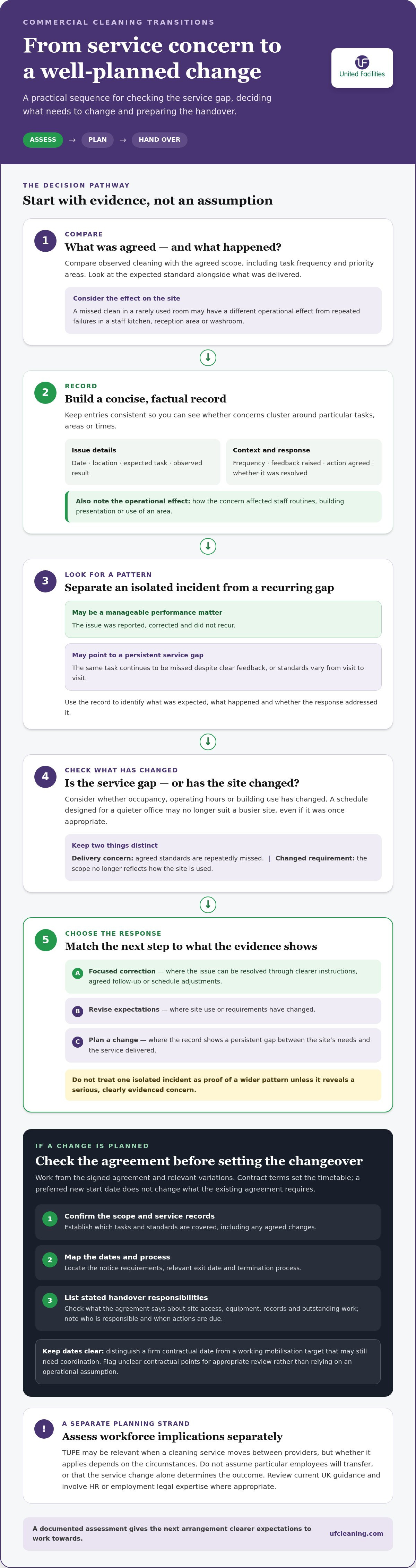
A concern about cleaning quality deserves a measured review, not an automatic decision to end the arrangement. Some issues can be resolved with clearer instructions, agreed follow-up or schedule adjustments. The key is to establish whether the problem is occasional and resolved, or a recurring gap between what the site needs and what the service delivers.
A documented service gap is a recurring difference between agreed standards and observed delivery. This gives your decision a practical basis: identify what was expected, what happened and whether the response addressed it. A general Commercial Cleaning Overview can help frame the range of tasks involved, but your agreement and site priorities should guide the assessment.
How to assess whether the current arrangement still fits
Compare observed cleaning with the agreed scope, including task frequency and priority areas. A missed clean in a rarely used room may have a different operational effect from repeated failures in a staff kitchen, reception area or washroom. Record the location, date, task and impact, then look for patterns.
Review recurring concerns alongside the contractor’s responses and follow-up actions. If an issue was reported, corrected and did not recur, it may be a manageable performance matter. If the same task continues to be missed despite clear feedback, or standards vary from visit to visit, the problem may be more persistent. Also consider whether occupancy, operating hours or building use has changed. A schedule designed for a quieter office may no longer suit a busier site, even if it was once appropriate.
How to prepare a clear case for change
Before deciding, make a concise record that separates evidence from impression. Keep entries factual and consistent to see whether concerns cluster around particular tasks, areas or times. This record can also help define what needs to change in the next arrangement, rather than carrying vague expectations forward.
- Record the issue: note the date, location, expected task and observed result.
- Track its frequency: distinguish a single incident from repeated occurrences.
- Capture the response: record the feedback raised, actions agreed and whether the issue was resolved.
- Describe the operational effect: explain how the concern affected staff routines, building presentation or use of an area.
Then separate standards that need improvement from requirements that have changed. Repeatedly missed floor cleaning, for example, points to a delivery concern, while newly occupied rooms may mean the scope needs updating. Avoid treating one isolated incident as proof of a wider pattern unless it reveals a serious, clearly evidenced concern.
This switching commercial cleaning contractors guide starts with that distinction because it shapes the next decision: whether to seek a focused correction, revise expectations or plan a change. A well-documented assessment creates a useful basis for reviewing the agreement and preparing a scope that reflects how the site operates now.
Review the cleaning contract and workforce implications before changing
Once you’ve established what needs to improve, review contractual and workforce questions before setting a changeover date. Keep the two strands distinct: the agreement sets out the parties’ contractual position, while workforce implications need a separate, informed assessment. Coordinate contract exit planning and workforce planning, rather than treating them as separate timelines.
Which contract details shape the changeover
Work from the signed agreement and any relevant variations, rather than an informal understanding of how the service operates. Locate the agreed cleaning scope, notice requirements, exit date provisions and termination process. These terms determine the contractual timetable. Don’t assume a preferred start date for a new arrangement changes what the existing agreement requires.
Next, identify any handover responsibilities stated in the contract. These may cover site access, equipment, records or outstanding work. Record what the agreement says, who is responsible and when each action is due. If a point is unclear, flag it for appropriate contractual review instead of treating an operational assumption as an agreed obligation.
- Scope and service records: establish which tasks and standards are covered, and note any agreed changes.
- Dates and process: map the notice period, relevant exit date and steps for ending the arrangement.
- Handover matters: list responsibilities for access, equipment, records and unresolved actions where the agreement addresses them.
This gives procurement and operations a shared reference for planning. It also distinguishes a firm contractual date from a working mobilisation target that may still need coordination.
How to approach TUPE and workforce continuity
TUPE may be relevant when a cleaning service moves between providers, but whether it applies depends on the circumstances. Don’t assume particular employees will transfer, or that the service change alone determines the outcome. Review current UK guidance and involve HR or employment legal expertise where a workforce transfer may be in scope.
Bring the appropriate people into the conversation early. HR can help assess workforce questions, legal advisers can assist with interpreting obligations, procurement can manage contract dates, and operational leads can identify the information and access needed to maintain site routines. Keep sensitive workforce information within the proper channels and agree who is responsible for each next step.
For a UK changeover, ground the workforce assessment in current guidance and the circumstances of the service arrangement. Separate confirmed contractual dates from workforce questions that need specialist review, so operational preparations can progress without treating assumptions as settled outcomes.
This switching commercial cleaning contractors guide uses the contract review to create a shared timeline: record contractual dates, identify workforce questions for specialist review, then align operational preparation with both. UF Cleaning supports recurring commercial cleaning with tailored schedules, helping organisations define the service expectations that follow mobilisation. Explore UF Cleaning’s commercial cleaning support as you shape the next arrangement.
Define the new cleaning scope and standards before mobilisation
A new agreement is an opportunity to shape the service around how the site works now. Turn operational needs into clear tasks, frequencies and observable outcomes before mobilisation, so both parties understand what the service covers and how it will be reviewed. Address gaps between the existing schedule and current priorities now, rather than carrying unclear expectations into the next arrangement.
Turn site requirements into a practical service brief
Describe the building in operational terms: areas in use, occupancy patterns, operating hours, access windows and locations needing particular attention. Separate routine cleaning from periodic or specialist work, and specify the required frequency for each. Daily care for a staff kitchen, for example, differs from a periodic carpet clean; include both where they fit the site brief.
A concise comparison helps turn those details into an actionable scope:
| Current need | Required outcome | Monitoring evidence |
|---|---|---|
| Washrooms used throughout the working day | Specified surfaces and fittings cleaned to an agreed frequency | Task records and logged observations |
| Reception and shared floors | Visible debris removed and floor presentation maintained | Scheduled checks against agreed criteria |
| Carpets or windows requiring periodic attention | Specialist task completed to the agreed scope and timing | Completion record and review notes |
Use the brief to distinguish what must remain consistent from what can be tailored as site use changes. UF Cleaning provides recurring commercial cleaning and specialist support, with schedules shaped around organisational requirements. Read UF Cleaning’s commercial cleaning information as you consider how the new scope can reflect your building’s routines.
Set standards and quality checks that can be reviewed
Replace broad phrases such as “excellent cleaning” with visible results. State which areas and surfaces are covered, what completion looks like, how often tasks occur and who is responsible for raising or reviewing concerns. Facility management resources, including Facility Management Best Practices, can provide wider context for organising site services. Your brief should still specify the practical standards for your building.
Agree the reporting route before work begins. Set out where an issue is recorded, who receives it, who assigns follow-up and how resolution is reviewed. Choose a review frequency that suits the service and site, with a process for updating the scope when occupancy or operations change. This helps distinguish a missed task from a requirement that needs revising.
UF Cleaning uses the Taskbe platform for real-time quality monitoring. This can make service observations more visible against agreed expectations and support structured review after mobilisation. A defined scope and evidence-based checks turn expectations into practical controls that can be discussed and refined over time.
How to mobilise a new cleaning contractor without avoidable disruption
A confirmed start date is only one part of a controlled changeover. Continuity depends on clear ownership and timely information, not assumptions about who will manage access, communicate changes or resolve early issues. Mobilisation means coordinating people, site information, schedules and quality controls.
Use a shared timeline that works back from the agreed service commencement date. For each action, name an accountable owner and record the deadline, completion status and any dependency. For multiple sites, track readiness separately when access, operating patterns or local priorities differ.
Build a mobilisation timeline with named responsibilities
Keep the sequence practical: settle the dates and scope first, prepare the site next, then brief the people involved before service begins. This makes dependencies visible and gives operational teams a clear route to raise anything that could affect readiness.
- Confirm dates and ownership. Align the agreed start date with the outgoing arrangement and assign a client-side lead and contractor contact for mobilisation decisions.
- Prepare site information. Organise relevant access arrangements, site routines, priority tasks and records through agreed channels. Identify who can authorise access and who should receive operational updates.
- Check readiness. Confirm that the cleaning schedule reflects the agreed scope and that the arrangements for the first shift are understood by the responsible people.
- Brief the team before commencement. Cover site-specific priorities, access procedures, expected standards and the route for escalating an issue. Allow time for questions so assumptions can be resolved before work starts.
- Review early delivery. Arrange an initial quality review against the agreed standards, record observations and assign follow-up actions to a named owner.
Manage handover, communication and early review
A useful handover is selective and clear. Share information that helps the incoming team understand how the site operates, including access arrangements, sensitive or high-priority areas, task timings and relevant records. Keep contractual exit responsibilities distinct from day-to-day operational preparation, and route workforce matters through the appropriate internal stakeholders.
Tell affected staff and site contacts what is changing, when the new service begins and where to raise concerns. Give them one clear reporting route, rather than relying on informal messages that may not reach the person responsible. For example, record a concern about an overlooked shared area with its location and details, then assign it for follow-up and review.
At the first-shift briefing, confirm the agreed schedule, priorities and escalation route. After service begins, compare observations with the specified outcomes, document gaps and agree who will address them. UF Cleaning uses the Taskbe platform for real-time quality monitoring, supporting visibility of service quality during ongoing delivery.
This switching commercial cleaning contractors guide treats mobilisation as a managed sequence, not simply a date in a diary. To plan recurring commercial cleaning around your site’s requirements, explore a tailored cleaning arrangement with UF Cleaning.
How UF Cleaning supports a considered commercial cleaning transition
Once you’ve clarified the scope, standards and changeover priorities, put them into a practical recurring service. UF Cleaning works with organisations to shape commercial cleaning around their site requirements, so the agreed arrangement reflects how different areas are used and what matters most to day-to-day operations. The service approach draws on experience supporting organisations since 2010.
A considered transition starts with the requirements you’ve identified: the spaces to be cleaned, the routine each area needs and any specialist tasks in the brief. These details help shape a tailored arrangement, rather than assuming the same schedule or service mix will suit every building.
A tailored service for ongoing site requirements
UF Cleaning provides recurring office cleaning and housekeeping, with flexible schedules that can be aligned with operational needs. An office may need regular attention to shared spaces, while another site may have distinct housekeeping priorities. Specialist work, such as carpet, window or hard-floor cleaning, can form part of the service where it fits the organisation’s requirements. Eco-friendly products are also part of the service.
Agreeing the scope and schedule around your priorities gives the ongoing service a clear foundation. It also keeps routine cleaning distinct from specialist tasks, so expectations remain understandable as operational requirements evolve.
Visible quality control and a straightforward next step
Clear expectations are more useful when service delivery can be reviewed against them. UF Cleaning uses the Taskbe platform for real-time quality monitoring, providing visibility to support conversations about performance and follow-up. Combined with a defined scope and tailored schedule, monitoring gives the organisation a practical reference for reviewing delivery.
UF Cleaning also provides 24/7 operational support. The arrangements, schedule and monitoring approach are shaped around the organisation’s needs, with clear expectations established for the service.
If you’re preparing to switch, use your documented priorities and agreed transition plan as the starting point for the next arrangement. This switching commercial cleaning contractors guide has covered the key planning stages; UF Cleaning can help translate your requirements into a tailored commercial cleaning proposal. Request a free quote for a tailored commercial cleaning arrangement.
Make your next cleaning arrangement fit for the future
A contractor change is also an opportunity to create a service that can adapt as your organisation’s needs evolve. Keep the agreed standards useful beyond the handover by reviewing them as building use, occupancy and priorities change. This helps the arrangement stay aligned with the environment it supports, rather than becoming a fixed schedule that no longer reflects daily operations.
Use this switching commercial cleaning contractors guide as the starting point for a considered conversation about your requirements. UF Cleaning can shape a tailored commercial cleaning arrangement around your site and priorities, with a clear scope to guide the next steps.
Request a free quote for tailored commercial cleaning and take the next step towards a service designed around your organisation. A well-planned change can open the way to a more suitable ongoing arrangement.
Frequently Asked Questions
Is there a best time of year to switch commercial cleaning contractors?
There’s no single best time of year; the right date depends on your contract, site calendar and workload. A quieter period may give teams more time to prepare, but it won’t suit every organisation. Work backwards from the planned start date and allow time for decisions, communication and site preparation. This switching commercial cleaning contractors guide can help you identify the steps to complete before choosing a date.
Can a cleaning contractor change be phased across several sites?
Yes, you can phase a change across sites if a staged approach better suits your operations. For example, you might bring one location into the new arrangement first, then use what you learn to refine preparations elsewhere. Keep a central schedule alongside site-level readiness notes, so shared standards remain consistent while local routines are respected. Don’t start a site until its access arrangements, brief and responsibilities are ready.
Do we need to change our cleaning specification when we change contractors?
No, you don’t necessarily need to replace a specification that still reflects how the site is used. Treat it as a working baseline, then check whether any details need clarification or revision. A change in room use, for instance, may make an existing frequency unsuitable, while an observable task description can prevent different interpretations. Preserve relevant requirements, make updates explicit and share one current version with everyone involved.
Can we keep our existing cleaning products during a contractor change?
Product arrangements should be agreed as part of the service scope, rather than assumed to continue. Record any site preferences, restrictions or handling information in the transition brief, and clarify who is responsible for products and related procedures. If the incoming service supplies products, align that arrangement with the tasks required. Note any product-specific site instructions before the start date so they can be considered during planning.
Should employees be told when the cleaning contractor is changing?
Yes, a timely, factual update can help employees understand what to expect. Explain the planned start date, any relevant changes to cleaning routines and the route for raising operational feedback. If a shared kitchen will be serviced at a different time, for example, tell the teams who use it before the change takes effect. Coordinate communications with relevant internal colleagues when workforce or contractual matters need careful handling.
What should we do if service quality dips during the transition?
Record the specific concern and report it through the agreed operational channel. Include the location, task, date and observed result, then compare it with the agreed standard. A missed task in one area may be an isolated handover issue, while repeated gaps could point to a process that needs attention. Track the response and follow-up, and escalate unresolved concerns through the named operational contacts rather than relying on informal messages.